

- Use the 5‑Minute Rule – Commit to just 5 minutes of work. You’ll likely keep going once you start.
- Kill perfectionism – Make an “ugly first draft.” You can’t edit a blank page.
- Reverse‑engineer deadlines – Break big tasks into tiny daily steps + always add a buffer day for surprises.
- Increase friction for distractions – Put your phone in another room, log out of social media, use site blockers.
- Try the “One Song Method” – Work for the length of one 3‑minute song. Repeat as needed.
- Get an accountability partner – Text someone your deadline + a small consequence if you miss it.
- Single‑task – No multitasking. Close all tabs except the one you need.
- Reward yourself – Small treat (chocolate, 5 min video) after finishing a chunk of work.
- If you miss a deadline – Send a one‑sentence update, cut the scope, and forgive yourself immediately.
- Do the #1 task first thing – Before email or social media. Every morning.
The clock reads 11:17 PM. A student named Jordan stares at a blank screen. The history essay is due tomorrow morning at 8 AM. Jordan has known about this deadline for two full weeks. Yet here he sits, wide awake, with nothing written except the title. His heart races. His palms sweat. He whispers, “Why do I always do this to myself?”
Sound familiar? You are not alone. Procrastination is the number one reason students lose points, lose sleep, and lose confidence. But here is the good news: procrastination is not a personality flaw. It is a habit. And habits can be broken.
This post follows real students like Jordan who learned to beat the delay game. You will discover why we procrastinate, how to trick your brain into starting early, and simple systems that keep deadlines firmly on your radar. No more all-nighters. No more last-minute panic. Just steady, calm progress.
The Real Cost of Putting Things Off
Let’s meet Maya, a tenth grader with big dreams but a terrible habit. She would receive a project on Monday, tell herself “I have plenty of time,” and then do nothing until Thursday night. By Thursday, the project felt huge and scary. She would stay up until 1 AM, produce mediocre work, and turn it in exhausted. Her grades suffered, but worse, she started believing she was “lazy.”
Maya is not lazy. She was stuck in the procrastination cycle.
What that cycle looks like:
- Step 1: A deadline feels far away. You feel no urgency.
- Step 2: You avoid the task because it seems boring or hard.
- Step 3: Time passes. Anxiety builds.
- Step 4: You finally start in a panic, rush through it, and feel terrible.
- Step 5: You swear “next time will be different.” But next time, the cycle repeats.
Research from psychology professor Dr. Piers Steel shows that 80% to 95% of students procrastinate regularly. The average student loses up to 3 hours per day to avoidance behaviors – checking phones, watching videos, reorganizing a desk instead of working.
But the cost is not just time. Chronic procrastinators have higher stress levels, worse sleep, and lower GPAs by an average of 0.5 points. That is the difference between a B+ and an A- or between a C+ and a B-.
The good news? You can rewire your brain. Let us show you how.
Why Your Brain Chooses Short-Term Relief

Procrastination is not a moral failing. It is a battle between two parts of your brain.
The limbic system (your “animal brain”) craves immediate pleasure – scrolling TikTok, eating a snack, playing a game. The prefrontal cortex (your “smart brain”) handles planning, foresight, and long-term goals. The limbic system is stronger and faster. It screams, “Do the fun thing NOW!” The prefrontal cortex whispers, “You will regret this later.” Guess who usually wins?
Real student experience: Carlos, a seventh grader, knew he had a math test on Friday. On Monday, he told himself, “I will study tomorrow.” Tuesday became Wednesday. Wednesday became Thursday night at 9 PM. He crammed for two hours, got 4 hours of sleep, and bombed the test. His limbic system won all week.
The solution? You do not defeat the limbic system with willpower alone. You outsmart it with tricks and systems.
5 Proven Strategies to Beat Procrastination

These are not theoretical ideas. Real students have used these methods to transform their work habits. Pick two to start.
1. The 5-Minute Rule
The hardest part of any task is starting. Once you begin, momentum kicks in. The 5-Minute Rule tricks your brain into overcoming that initial resistance.
How it works: Tell yourself, “I will work on this for just five minutes. After five minutes, I can stop if I want to.”
What happens: Your brain agrees because five minutes feels easy. You open your textbook, write one sentence, or solve one problem. Almost always, after five minutes, you keep going. Starting is the only battle.
Real example: Emma, a ninth grader, dreaded her biology reading. She used the 5-Minute Rule every night. After five minutes, she usually read for 20 more minutes without noticing. She finished her readings three days early before every test.
2. Break Big Deadlines Into Tiny Daily Tasks
A ten-page research paper due in three weeks feels far away. So your brain ignores it. But if you break that paper into daily micro-tasks, the deadline feels real and manageable.
Example – 10-page history paper (21 days):
- Day 1: Choose topic (10 minutes)
- Day 2: Find 3 sources (15 minutes)
- Day 3: Write 5 bullet points for intro (10 minutes)
- Day 4: Write paragraph 1 (20 minutes)
- …and so on.
Each task takes 30 minutes or less. No single day feels overwhelming. And you finish days before the deadline, leaving time to proofread.
Experience from a high school junior: Liam used to write every paper the night before. His grades were C’s and D’s and teacher showed him how to break projects into daily chunks. His next paper earned a B+. He said, “I could not believe how easy it felt. I spent 30 minutes a day instead of 5 hours in panic mode.”
3. Use a Visible Deadline Tracker
Out of sight often means out of mind. If your deadlines live only in your head or a phone app you ignore, they do not feel real. Make them visible.
What works:
- Hang a large wall calendar in your study area. Write every due date in red marker.
- Use sticky notes on your desk or mirror. Move them closer as the deadline approaches.
- Set three reminders for every deadline: one week before, three days before, and the night before.
Real student story: Sophia, an eighth grader, kept forgetting her Spanish quizzes. She put a bright pink sticky note on her bathroom mirror that said “Spanish quiz – Thursday!” She saw it every morning and night. She never missed another quiz and raised her grade from C to B+.
For more visual planning ideas, this resource shares helpful methods that work for all grades.
4. Remove Distractions Before You Start
Willpower is a limited resource. If your phone sits next to you while you study, you will eventually check it. The smart move? Remove the temptation entirely.
Practical steps:
- Put your phone in another room or a locked drawer.
- Use apps like Forest, Focusmate, or Cold Turkey to block social media during study hours.
- Study in a quiet space away from TV, siblings, or noisy areas.
- Use noise-canceling headphones or play white noise.
One student’s transformation: Noah, a tenth grader, lost 2 hours every night to YouTube rabbit holes. He started leaving his phone in the kitchen while studying in his room. His homework time dropped from 3 hours to 1.5 hours. He gained back 10 hours per week.
5. Pair Hard Tasks With Small Rewards
Your brain releases dopamine when you anticipate a reward. Use that chemistry to your advantage.
How to pair:
- “After I finish 20 math problems, I will watch one 10-minute YouTube video.”
- “After I write one page of my essay, I will eat a piece of chocolate.”
- “After I study for 30 minutes, I will play 15 minutes of my favorite game.”
Important: The reward must be small and immediate. “I will buy myself a new video game after finals” is too far away. Your brain does not care about distant rewards.
Real experience: Mia, a sixth grader, hated practicing multiplication tables. She set a timer for 15 minutes of practice, then allowed herself 5 minutes of drawing. She finished her tables in one week instead of three.
How to Stay on Track With Multiple Deadlines

Many students do not just have one deadline. They have math homework due Wednesday, science project due Friday, Spanish quiz Thursday, and history essay next Monday. Juggling all that without procrastinating requires a system.
The Weekly Review (Every Sunday, 15 minutes)
Sit down with your planner and a cup of hot chocolate. Look at the coming week. Write down every single deadline. Then ask:
- “What is due tomorrow?” – Do that first.
- “What big project needs daily small steps?” – Schedule those steps.
- “What day looks overloaded?” – Move something to an earlier day.
Real student: Ethan, a high school freshman, used to wake up every morning surprised by a deadline. He started a Sunday night review and never missed another assignment. His mom said, “He went from chaotic to calm in three weeks.”
The Daily Top 3 (Every morning, 2 minutes)
Before you start your day, write down three tasks that must get done. Not twenty. Three. Complete those before anything else.
Why it works: A long to-do list feels overwhelming. Your brain wants to avoid it. A short list of three priority tasks feels achievable.
Example:
- Finish math worksheet (due tomorrow)
- Write outline for science report (due Friday)
- Study Spanish vocabulary for 10 minutes
Once those three are done, anything else is a bonus.
What to Do When You Already Procrastinated
Sometimes, despite your best efforts, you fall behind. Maybe you ignored a deadline for five days. Now it is the night before and you have four hours of work left. Do not panic. Do not give up.
The emergency action plan:
- Accept reality – “I procrastinated. It happens. Now I fix it.”
- Cut your losses – Decide what is essential versus what can be skipped or simplified.
- Use the Pomodoro method – Work for 25 minutes, break for 5 minutes. Repeat.
- Ask for help – Email your teacher. Some will give a one-day extension if you are honest.
- Sleep at a reasonable hour – Pulling an all-nighter lowers your brain function by 30% , making your work worse.
Real story: Chloe, an eleventh grader, forgot about a major English essay until the night before. She panicked for 10 minutes, then used the emergency plan and she wrote a shorter but high-quality essay, emailed her teacher explaining the situation, and received a one-day extension. She finished the next morning and earned a B. Not perfect, but far better than a 0% .
Understanding the importance of rest during crisis moments is critical. Here is why sleep directly impacts your grades – even when you are racing a deadline.
How Peer Pressure and Social Life Affect Procrastination

Let’s be honest. Sometimes you procrastinate because your friends are hanging out, texting, or playing games. You do not want to miss out. That is peer pressure – not the dramatic kind, but the quiet, everyday kind.
The reality: Every time you choose a group chat over your homework, you are borrowing time from your future self. That future self will pay the price with stress and lower grades.
But you do not have to be antisocial. You just need boundaries.
Strategies that work:
- Study first, then socialize – “I will finish my math, then I will text you back.”
- Use “do not disturb” mode during your focused work blocks.
- Find a study buddy who actually studies. You can sit together quietly for 30 minutes, then chat for 5 minutes.
Real example: Jayden, a seventh grader, constantly checked his phone because his friends sent memes all night. His grades dropped from B’s to D’s. He started putting his phone in a drawer from 6 PM to 8 PM every night. He told his friends, “I am offline during those hours.” They adjusted. His grades returned to B’s in six weeks.
For a deeper look at how social dynamics affect schoolwork, this article explains the connection . It includes scripts for saying “no” to distractions politely.
The Link Between Organization and Procrastination
Disorganization fuels procrastination. When your backpack is a mess, your desk is cluttered, and your planner is empty, every task feels harder to start. You waste time searching for things and forget deadlines until the last minute. You feel overwhelmed by invisible work.
The fix: Get organized. An organized student knows exactly what to do and when. There is no “I cannot find the worksheet” excuse. There is no “I forgot we had a test” panic.
One simple organization habit that kills procrastination: Every afternoon, spend 5 minutes sorting your papers and checking your planner for tomorrow’s deadlines. That small habit eliminates 90% of last-minute surprises.
For a complete guide on building these systems, this resource shares practical steps that work alongside anti-procrastination strategies.
How Extracurriculars and Daily Routines Help
Busy students often procrastinate less than students with too much free time. Why? Because when your schedule is packed, you cannot afford to waste time. You know you have band practice from 4-5 PM and homework from 5:30-7 PM. You just do it.
The lesson: Fill your schedule with meaningful activities. You will naturally manage your time better.
But be careful. Too many activities – four or more – lead to burnout. You start procrastinating because you are exhausted.
The sweet spot: Two to three extracurriculars plus a consistent daily routine.
What a healthy routine looks like:
- Wake up at the same time every weekday.
- Study in focused blocks (e.g., 45 minutes on, 10 minutes off).
- Eat meals at regular times.
- Go to bed at a consistent hour.
Students with regular routines procrastinate 40% less than students with chaotic schedules. Your brain craves predictability.
Learn how activities affect your study habits in this detailed guide . It includes a worksheet to help you find balance.
Building Healthy Routines That Prevent Procrastination
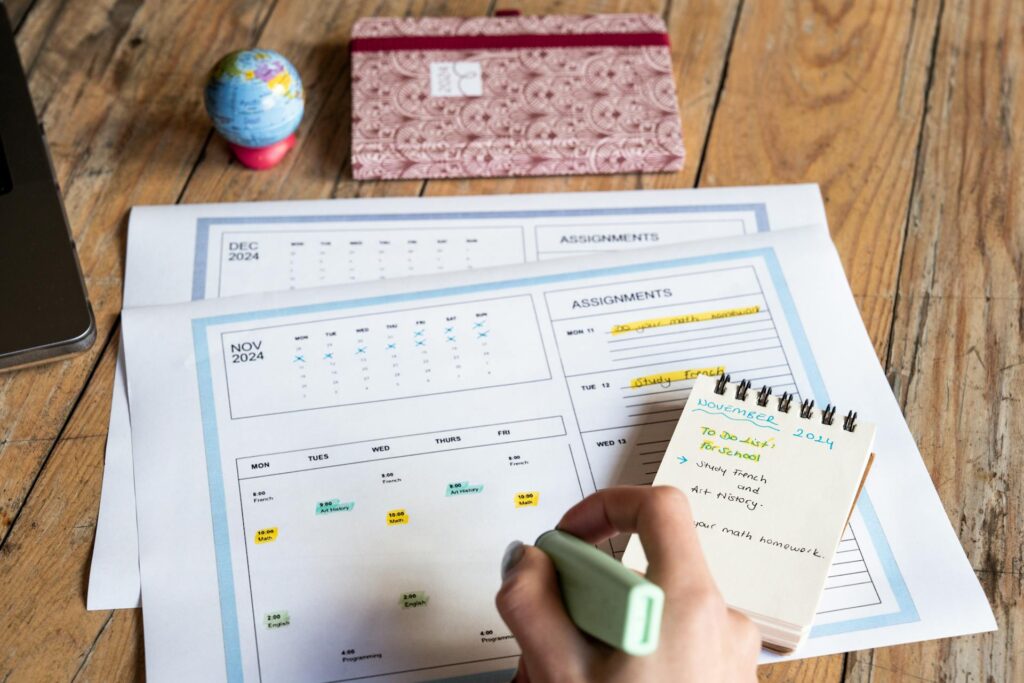
Procrastination thrives in the absence of structure. When you wake up at different times, eat whenever, and study randomly, your brain never enters “work mode.” Everything feels optional. Delaying feels easy.
The solution: Build non-negotiable daily routines.
Morning routine (10 minutes):
- Wake up, wash face, eat something.
- Review your Top 3 tasks for the day.
- Pack your backpack (do not leave without everything).
After-school routine (10 minutes):
- Unpack immediately.
- Eat a snack and drink water (hunger = distraction).
- Set a timer for your first 25-minute work block.
Evening routine (10 minutes):
- Check tomorrow’s deadlines.
- Pack your bag and set out clothes.
- Charge your devices.
- Go to bed at the same time every night.
Real student experience: Isabella, a ninth grader, used to procrastinate until 10 PM. She started a strict after-school routine – snack, then one hour of homework before any phone time. Within two weeks, she finished everything by 6:30 PM and had three hours of free time every night. She said, “I could not believe I wasted so many evenings stressing.”
For a full guide on building routines that stick, this resource offers a step-by-step plan . It includes a sample weekly schedule.
Summary
Core insight: Procrastination isn’t laziness—it’s an emotional coping mechanism to avoid stress or fear.
Key strategies:
- 5‑Minute Rule – Start with just 5 minutes of work. The hardest part is beginning.
- Kill perfectionism – Create an “ugly first draft.” You can’t edit a blank page.
- Reverse‑engineer deadlines – Break tasks into small daily steps, and always include buffer days for delays.
- Control your environment – Increase friction for distractions (phone in another room, website blockers) and decrease friction for good habits (pre‑open documents, leave materials visible).
- One Song Method – Work for the length of one 3‑minute song; repeat as needed.
- Accountability partner – Share your deadline with someone and add a small consequence for missing it.
- Single‑task – No multitasking; close all other tabs and use a “distraction notebook.”
- Micro‑rewards – Give yourself a small treat (dark chocolate, a short video) after completing a work chunk.
- Recovery plan for missed deadlines – Send a one‑sentence update, reduce the scope, and forgive yourself.
- Do the #1 task first – Before email or social media each morning.
Bottom line: Motivation fades, but a system works. Start with 5 minutes right now.
Final Thoughts: You Can Break the Procrastination Habit
Remember Jordan from the beginning? The student staring at a blank screen at 11:17 PM? Jordan learned the 5-Minute Rule. He started breaking projects into tiny daily tasks and put his phone in another room. He built a nightly routine.
Six months later, Jordan finished his history essay four days early. He proofread it calmly. He went to bed at 10 PM and woke up feeling ready. His grade? An A-. He almost cried when he saw it – not because of the grade, but because he proved to himself that he could change.
You can change too. Procrastination is not who you are. It is just a habit you learned. And you can learn a new one.
Pick one tip from this post. Try it tomorrow. Just one. Then add another next week. Within a month, you will wonder why you ever waited until the last minute.
The deadline is not your enemy. It is just a date on a calendar. With the right systems, you will meet every one of them calmly, confidently, and maybe even early.
FAQs
Why do students procrastinate even when they know it causes stress?
Students procrastinate because their brain’s limbic system (the part that seeks immediate pleasure) overpowers their prefrontal cortex (the planning part). A task that is boring, hard, or has a faraway deadline feels less urgent than scrolling on a phone or watching a video. This is not laziness – it is biology. The good news is that you can trick your brain with small starts, like the 5-Minute Rule, which makes beginning feel easy. Once you start, momentum takes over.
What is the 5-Minute Rule and how does it stop procrastination?
The 5-Minute Rule is simple: tell yourself you will work on a task for just five minutes. After five minutes, you can stop if you want. Almost always, you keep going because starting is the hardest part. Real students have used this rule to finish essays, study for tests, and complete projects days before deadlines. It works because your brain agrees to five minutes easily – but once engaged, it rarely wants to quit.
How can I stop procrastinating when I have multiple deadlines at once?
Use two powerful tools: the Weekly Review and the Daily Top 3. Every Sunday, spend 15 minutes looking at the coming week. Write down every deadline, then break big projects into tiny daily tasks (e.g., “write one paragraph today”). Every morning, write down your Top 3 priority tasks – only three. Complete those before anything else. This system prevents feeling overwhelmed and keeps you working on what actually matters each day.
What should I do if I already procrastinated and the deadline is tomorrow?
Do not panic. Use the emergency action plan: First, accept reality and stop blaming yourself. Second, decide what is essential versus what can be simplified or skipped. Third, work in 25-minute focused blocks (Pomodoro method) with 5-minute breaks. Fourth, email your teacher honestly – some will grant a one-day extension. Finally, get at least 6 hours of sleep; an all-nighter lowers your brain function by 30% , making your work worse. A calm, shortened effort beats a panicked, sleepless mess.
Can having a daily routine really stop me from procrastinating?
Yes, dramatically. Students with consistent daily routines procrastinate 40% less than those with chaotic schedules. A routine removes the need for willpower. When you always study from 4 PM to 6 PM, your brain enters “work mode” automatically – no negotiation, no delaying. A simple routine includes: a fixed wake-up time, an after-school snack followed by one hour of focused work, and an evening backpack pack-up. Within two weeks, procrastination feels unnatural because your brain expects work at certain times.