

- Study in Short Bursts — Use the Pomodoro method: 25 min study, 5 min break
- Teach the Material — Explain concepts to someone else using the Feynman Technique
- Color-Coded Notes — Assign specific meaning to each color consistently
- Weekly Study Schedule — 30 minutes daily beats 4-hour cram sessions
- Turn Notes Into Questions — Do it before bed to boost overnight memory
- Right Study Environment — Find a consistent space, not just a quiet one
- Use Mnemonics — Create memory tricks for hard facts and long lists
- Hardest Assignment First — Tackle tough tasks when brain is freshest
- Review Notes Within 24 Hours — Fights the Forgetting Curve (70% info lost otherwise)
- Ask Questions — Even the “foolish” ones, privately if needed
- Sleep, Food & Movement — 8–10 hours sleep, real meals, 10-min daily walk
Middle school hits differently. One day, a student is breezing through elementary school with minimal homework and zero stress. The next, they are sitting at a desk staring at three different assignments due tomorrow, a science test on Friday, and absolutely no idea where to start. It is a transition that catches a lot of kids off guard — and their parents too.
Here is the truth that does not get said enough: middle school success is not about being the smartest kid in the room. It is about having the right strategies. Students who learn how to study — not just how to sit with a textbook — are the ones who build real confidence, real knowledge, and real results. The 11 tips below are not recycled advice. They are practical, experience-based strategies that work for real students in real classrooms.
1. Study in Short Bursts, Not Long Marathons

One of the biggest mistakes middle schoolers make is sitting down for a 2-hour study session and expecting their brain to stay sharp the entire time. It simply does not work that way — not for adults, and definitely not for 11 to 14-year-olds whose attention spans are still developing.
A much smarter approach is the Pomodoro Technique: study hard for 25 minutes, then take a 5-minute break. After completing 4 rounds, take a longer break of 20 to 30 minutes. During breaks, students should step away from the desk — stretch, grab a snack, or get some fresh air. The key is to truly disconnect for those few minutes so the brain can reset.
Students who use this method consistently report feeling less mentally exhausted after study sessions and remembering more during tests. That is not a coincidence — it is how the brain processes and stores information. Short, focused bursts of learning are far more effective than long, unfocused hours of staring at a page.
2. Teach the Material to Someone Else
Here is a strategy that most students never try — and the ones who do swear by it: teaching is one of the most powerful ways to learn. When a student tries to explain a concept to a younger sibling, a parent, a friend, or even a stuffed animal on their desk, they quickly discover exactly where their understanding breaks down.
This is known as the Feynman Technique, named after the brilliant physicist Richard Feynman, who believed that truly understanding something means being able to explain it simply. If someone stumbles trying to explain an idea in plain language, they have found a gap in their knowledge — and that is incredibly valuable information.
Middle schoolers can apply this after every study session. Pick one topic covered that day and explain it out loud as if teaching a curious 5th grader. No textbook language, no memorized definitions — just plain, simple explanation. It feels awkward at first, but after a few tries, students start to notice how much more confidently they can recall information during actual tests.
3. Use Color-Coded Notes — The Right Way
Color-coding notes is extremely popular among middle schoolers, but most students use it in a way that looks organized without actually being helpful. They highlight random sentences in random colors, which turns their notebook into a rainbow without any real meaning behind it.
The correct approach is to assign specific meaning to each color and stick to that system consistently:
- Yellow — main ideas or key concepts
- Green — examples, evidence, or supporting details
- Pink — questions that still need to be answered
- Blue — vocabulary words or definitions
- Orange — important dates, numbers, or names
When every color has a job, the brain starts organizing information differently. Reviewing notes becomes faster and more effective because the eyes know exactly where to look. Over time, this system also makes it easier to build study guides and prepare for exams without re-reading everything from scratch.
4. Build a Weekly Study Schedule and Actually Follow It
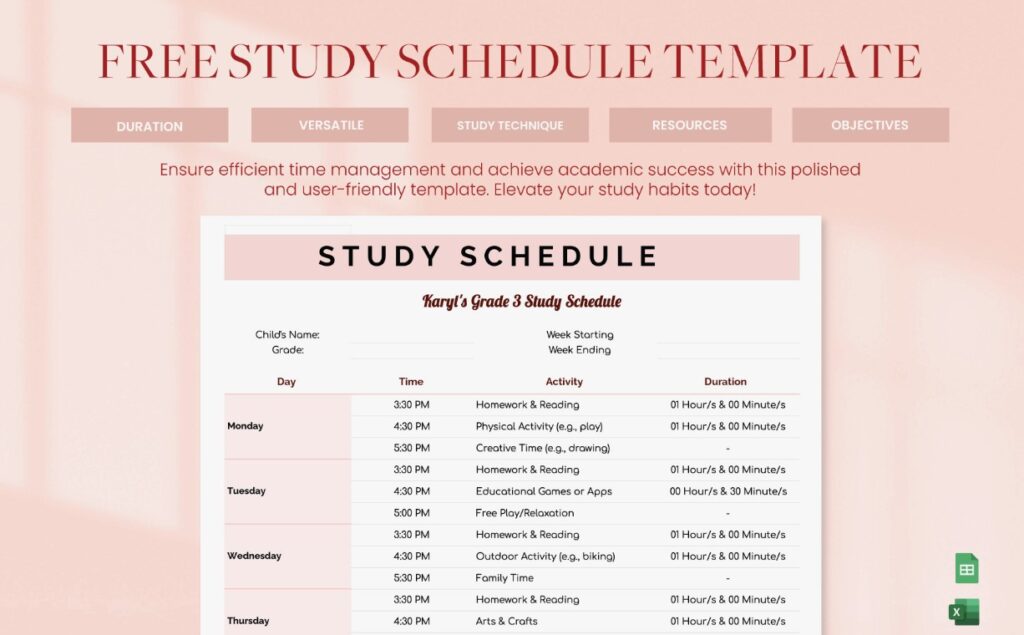
Waiting until the night before a test is a habit that turns middle school into an exhausting cycle of panic and poor performance. Students who build a weekly study schedule and follow it with even moderate consistency see results that feel almost unfair compared to those who cram everything into one stressful night.
A good schedule does not need to be complicated or overwhelming. It just needs to be realistic and repeatable:
- Monday and Wednesday — review class notes from that day for 15 to 20 minutes
- Tuesday and Thursday — work on upcoming assignments and long-term projects
- Friday — light review of the entire week’s material
- Saturday — free day, no studying required
- Sunday — 30 minutes to prepare for the upcoming week
The secret is consistency over intensity. Studying for 30 minutes every single day is dramatically more effective than cramming for 4 hours the night before a big exam. The brain learns through repetition over time, not through one desperate all-nighter.
5. Turn Notes Into Questions Before Bed
This tip takes less than 10 minutes and produces surprisingly strong results on memory and test performance. Right before going to sleep, students should flip through the notes they took that day and convert the main points into questions.
For example, if a note reads “The water cycle includes evaporation, condensation, and precipitation,” the question becomes: “What are the three stages of the water cycle?”
These questions can be written on index cards, in a separate notebook, or typed into a notes app. They become a ready-made quiz that the student can use in the days leading up to a test. More importantly, reviewing them right before bed gives the brain a clear signal about what to process during sleep. The brain consolidates memories overnight, and priming it with questions before sleep means that information is more likely to transfer into long-term memory.
Students who build this 10-minute habit often report needing significantly less review time before tests because the material already feels familiar.
6. Find the Right Study Environment — Not Just a Quiet One
Adults always tell students to find a “quiet place to study.” But quiet is not actually the magic ingredient — consistency is. Different students focus best in different environments. Some do their best work with soft instrumental music in the background. Others prefer the ambient noise of a kitchen or living room. A smaller number genuinely need complete silence.
None of these preferences is wrong. The important thing is to identify one environment that works personally and return to it regularly. Over time, the brain starts to associate that specific setting with focus and mental effort. Just walking into that space begins to trigger a studying mindset — the same way walking into a gym can make someone feel ready to work out.
What consistently does not work is studying in bed with a phone on the nightstand, the TV playing in the background, and notifications going off every few minutes. That environment actively trains the brain to be distracted. Even if a student feels like they are studying in those conditions, the quality and retention are significantly lower than in a dedicated, consistent study space.
7. Use Mnemonics and Memory Tricks for Hard Facts
Some subjects demand the memorization of long lists, sequences, dates, and terms. Trying to force this information into the brain by reading it over and over is one of the least efficient study methods that exists — yet it is what most students default to.
Mnemonics — memory devices that connect new information to something already familiar — work far better. The most well-known example is “Please Excuse My Dear Aunt Sally” for the mathematical order of operations (Parentheses, Exponents, Multiplication, Division, Addition, Subtraction). Students who learned that phrase in 4th grade often still remember it in high school.
The beauty of mnemonics is that students can create their own for any subject. Making up a rhyme for the planets, an acronym for the causes of World War I, or a vivid mental image for a vocabulary word takes only 2 to 3 minutes — but the memory can last for years.
The stranger, sillier, or more personal the association, the stronger the memory tends to be. The brain holds onto things that feel unusual or emotionally meaningful far better than plain lists of facts.
8. Tackle the Hardest Assignment First
Most middle schoolers begin their homework with the easiest task. It feels good to check something off quickly and build a sense of momentum. The problem is that this strategy leaves the most challenging and mentally demanding work for last — exactly when energy and concentration are at their lowest point in the session.
Reversing this order is a simple but powerful change. When students sit down to study, they should identify the hardest or most dreaded task and do it first, while the brain is still fresh and focused. Once that task is completed, every remaining assignment feels lighter by comparison. The rest of the session flows more easily and the overall quality of work improves across the board.
This approach also has a direct effect on procrastination. The harder a task seems, the more the brain wants to delay it. Starting with it immediately — before that avoidance instinct kicks in — removes the psychological weight that makes homework feel unbearable.
9. Review Notes Within 24 Hours of Class
One of the most well-documented findings in educational psychology is the Forgetting Curve, first described by researcher Hermann Ebbinghaus in the 1880s. His research showed that people forget approximately 70% of new information within 24 hours if they do not actively review it. This applies to every student, in every subject, at every grade level.
The solution is not complicated: within 24 hours of any class, spend 10 to 15 minutes reading back through the notes from that lesson. This single habit slows the forgetting process dramatically and means students retain far more without needing to re-learn everything from scratch before a test.
Students who also use a middle school calculator GPA tool to track their academic standing often find it easier to identify which subjects need more consistent review time — and they can adjust their weekly schedule to give those subjects extra attention before grades slip.
10. Ask Questions — Including the Ones That Feel “Foolish”

Middle school culture has a quiet but powerful effect on students: it makes them afraid to look confused. Nobody wants to raise their hand and ask something that feels obvious. Nobody wants their classmates to think they did not understand what everyone else seemingly did.
But the students who ask questions — especially the ones that feel too basic or too obvious — are consistently the ones who build the deepest understanding over time. Every experienced teacher has watched this pattern play out hundreds of times. The student who asked questions early catches up and keeps up. The student who stayed silent and hoped it would click eventually often falls further behind.
For students who feel uncomfortable asking in front of the class, there are other options. They can write the question down during the lesson and ask the teacher privately after class and can email the question that evening. They can look it up at home and then confirm their understanding with the teacher the next day. What matters is that no question stays unanswered. Every unanswered question becomes a small gap, and small gaps add up to big confusion over time.
11. Protect Sleep, Nutrition, and Physical Movement
Every study strategy in this article depends on one foundation: a brain that is actually functioning well. And no brain functions well on 5 hours of sleep, a skipped breakfast, and an entire day without moving.
Middle schoolers need 8 to 10 hours of sleep every night. During sleep, the brain consolidates the day’s learning and transfers short-term memories into long-term storage. Students who regularly cut sleep short are essentially erasing a portion of what they studied the day before. No amount of extra review time makes up for chronic sleep deprivation.
Nutrition matters just as much. The brain runs on glucose, and skipping meals — especially breakfast — causes energy crashes that make focusing in class nearly impossible. A real breakfast with protein and complex carbohydrates sets the brain up for a productive morning, which is when most of the hardest academic work happens.
Physical movement is the third piece. Even a 10 to 15 minute walk after school, before sitting down to study, increases blood flow to the brain, lifts mood, and improves concentration. Multiple studies have confirmed that regular physical activity improves academic performance — not because it makes students smarter, but because it keeps their brain and body in the condition needed to learn effectively.
These are not optional lifestyle suggestions. They are the non-negotiable foundation that every other study strategy rests on.
Summary
- Middle school is a big transition where personal responsibility increases and teachers stop reminding students about homework and reviews
- Success is not about being the smartest — it is about having the right study strategies and consistent habits
- Pomodoro Technique works best for focus — study for 25 minutes, break for 5 minutes, and take a longer 20 to 30 minute break after 4 rounds
- Teaching material to others using the Feynman Technique reveals knowledge gaps faster than any other review method
- Color-coded notes only work when each color has a specific meaning — yellow for main ideas, green for examples, pink for questions, blue for vocabulary
- A weekly study schedule removes last-minute panic — Monday and Wednesday for note review, Tuesday and Thursday for assignments, Friday for weekly recap
- Studying 30 minutes daily is far more effective than cramming for 4 hours the night before a test
- Turning notes into questions before bed primes the brain to consolidate information during sleep overnight
- Consistent study environment trains the brain to focus — studying in bed with TV and phone nearby actively builds distraction habits
- Mnemonics and memory tricks stick far longer than rereading — the stranger and more personal the association, the stronger the memory
- Hardest assignment first ensures the most challenging work gets done when energy and focus are at their peak
- Hermann Ebbinghaus research proved people forget 70% of new information within 24 hours without review — making same-day note review critical
- Asking questions — even ones that feel basic or embarrassing — builds deeper understanding and prevents small gaps from becoming big problems
- 8 to 10 hours of sleep is non-negotiable for memory consolidation and next-day focus
- Skipping breakfast causes energy crashes that make concentrating in class nearly impossible
- A 10 to 15 minute walk before studying increases blood flow to the brain and improves concentration
- Middle school is a training ground — students who build strong habits here arrive in high school confident, prepared, and genuinely ready
Final Thoughts
Middle school does not have to be a stressful, exhausting grind. With the right strategies in place early, it can actually become the period where a student discovers how they learn best, what subjects genuinely interest them, and what kind of academic habits they want to carry into high school and beyond.
The 11 tips above are not about working harder or longer. They are about working smarter — using what is known about how the brain learns and retains information to make every study session more effective. Start by choosing 2 or 3 of these strategies that feel most relevant right now. Build them into a routine over the next 2 to 3 weeks. Then add more.
The students who develop strong study habits in middle school are not the ones who happened to be born “smart.” They are the ones who figured out the system early — and used it consistently. That is a decision any student can make, starting today.
Progress in middle school is rarely dramatic or instant. It builds quietly, one good study session at a time, one reviewed lesson at a time, one asked question at a time. Parents and educators who support students in building these habits — rather than just pushing for better grades — are giving them something far more valuable than a report card number. They are giving them the tools to succeed in every academic challenge that comes next.
Middle school is not the finish line. It is the training ground. And the students who take it seriously, who invest in their habits and their mindset during these critical years, arrive in high school not just prepared — but genuinely confident, capable, and ready for whatever comes next.
FAQs
What are the best study tips for middle school students?
The best study tips for middle school students include using the Pomodoro Technique for focused study sessions, reviewing notes within 24 hours of class, teaching material out loud to someone else, building a consistent weekly study schedule, and protecting 8 to 10 hours of sleep every night.
How many hours should a middle school student study per day?
A middle school student should study for 1 to 2 hours per day depending on their workload. However, quality matters more than quantity. Studying for 30 focused minutes using short bursts with breaks is far more effective than sitting at a desk for 3 hours without real concentration.
How can middle school students improve their grades fast?
Middle school students can improve their grades quickly by reviewing class notes within 24 hours, asking teachers questions they do not understand, doing the hardest assignments first, and using mnemonics to memorize difficult material. Tracking progress with a GPA calculator also helps identify which subjects need the most attention.
Why do middle school students struggle with studying?
Middle school students struggle with studying because they lack structured study habits, rely on last-minute cramming, study in distracting environments, and do not get enough sleep. Most students were never taught how to study — only told to study, which is a critical difference.
What is the most effective study method for middle schoolers?
The most effective study method for middle schoolers is the combination of spaced repetition and active recall — reviewing material at regular intervals and testing themselves with questions rather than passively rereading notes. This approach works with how the brain naturally stores long-term memory and produces stronger results than any other single technique.