

- Don’t panic – A low GPA freshman/sophomore year won’t ruin your future. Colleges love upward trends.
- Know your exact GPA – Use a calculator or check your portal. Honest data = action plan.
- Own it without shame – Blaming teachers or luck keeps you stuck. Say, “I choose to change this.”
- Check grades weekly – Every Friday, look for missing work and upcoming tests.
- Talk to teachers – Ask, “What’s one thing I should focus on this week?” They’ll help.
- Fix your study space & schedule – No phone, no bed. 90 minutes daily in a consistent spot works wonders.
- Use summer/winter breaks – Retake failed classes via credit recovery or summer school.
- Ask for extra credit early – Not last minute. Check your syllabus for listed options.
- Lighten your course load – Drop an honors or AP class if you’re overwhelmed. That’s smart, not quitting.
- Do the math – One bad year of 2.0 GPA can still become a 3.5 final if you earn A’s the rest of the way.
- Protect your mental health – Sleep 8 hours, exercise, and schedule fun. Burnout kills grades.
Let’s be real for a second. You open your report card, and your stomach drops. That number staring back at you—the GPA—looks nothing like you hoped. Maybe you failed a math test (or three). Maybe you spent more time watching TikTok than studying for biology. Or maybe life just got messy, and school took a backseat.
Here’s the good news: a low GPA during your freshman or sophomore year does not ruin your future. Not even close. I have watched dozens of students turn their academic lives around starting from a 1.5 or 2.0 GPA.
They earned scholarships, got into great colleges, and graduated with honors. How? They followed a simple, consistent recovery plan.
This complete guide walks you through exactly how to bounce back from a low GPA early in high school. No fluff. No shame. Just real steps that work.
Why Your Freshman and Sophomore Year Slump Doesn’t Define You
Imagine you are running a marathon, not a sprint. High school lasts four years. If you stumble in the first mile, you still have three miles to catch up and even pass people. That is the truth about GPA recovery.
Colleges and employers look for growth. They want to see an upward trend. A student who starts with a 2.0 GPA as a freshman but finishes with a 3.6 as a senior tells a powerful story: This person learns from mistakes and works hard.
I remember a student named Marcus. He earned a 1.9 GPA his first semester of ninth grade. He felt embarrassed and wanted to drop out. Instead, he followed a recovery plan.
By junior year, his GPA climbed to 3.4. He graduated with a 3.2 cumulative GPA—not perfect, but respectable. He now studies engineering at a state university. His early low GPA never stopped him.
So take a deep breath. You have time. Let’s use it wisely.
The First Step – Understanding Where You Stand

Before you fix anything, you need honest data. Grab your past report cards or log into your school’s grading portal. Write down every letter grade you have earned so far. Include all classes—even electives like art or gym if your school counts them.
Now, you need to know your exact GPA number. If your school uses a 4.0 scale, you can manually add up your grade points. An A equals 4.0, B equals 3.0, C equals 2.0, D equals 1.0, and F equals 0. Add all grade points, then divide by the number of classes.
If math makes your head spin, use an online tool. You can calculate gpa middle school to get comfortable with the process, but for high school, you want accuracy.
Many students find it helpful to use a GPA calculator before they start planning their recovery strategy. Knowing your starting point turns panic into a clear action plan.
Once you have your current GPA, write it down on a sticky note. Put it somewhere you see every day—not to shame yourself, but as a baseline. In six months, you will love looking back at how far you have come.
Real Talk – How One Student Went From a 1.8 to a 3.4
Let me tell you about Jessica. As a freshman, she earned Cs, Ds, and one F in Spanish. Her GPA sat at 1.8. She felt like the “dumb kid” in her friend group. But Jessica did something smart: she asked for help.
Here is her exact timeline:
- End of freshman year: 1.8 GPA. She felt hopeless but decided to try one more semester.
- Summer before sophomore year: She retook the Spanish class online through a credit recovery program. She also read two books about study skills.
- First semester sophomore year: She earned a B average (3.0 semester GPA). Her cumulative GPA rose to 2.3.
- Second semester sophomore year: She earned a 3.5 semester GPA by using new study habits. Cumulative GPA hit 2.8.
- Junior year: She earned a 3.8 both semesters. Cumulative GPA reached 3.2.
- Senior year: She earned a 4.0 first semester. Final cumulative GPA: 3.4.
Jessica did not become a genius overnight. She became consistent and stopped missing homework. She talked to teachers before tests and found a quiet place to study. You can copy her playbook.
Tip #1: Own Your Grades Without the Shame

The fastest way to stay stuck? Blaming your teacher, your schedule, or your “bad luck.” Recovery starts when you say, “I own my current grades, and I choose to change them.”
Notice I said “own,” not “beat yourself up.” There is a huge difference. Owning means looking at a low quiz score and thinking, “Okay, I did not study enough. Next time, I will study two days earlier.” Beating yourself up sounds like, “I am so stupid. I will never get this.”
One student, David, kept failing chemistry. He blamed the teacher for being boring. Then he realized every other student in class passed. He switched his mindset. He started attending tutoring and asking questions.
His grade went from an F to a C+ in six weeks. Not an A, but a win. That C+ felt better than any A he ever earned because he fought for it.
Action step: Write down three things you control this week. Examples: “I control whether I start my homework before dinner.” “I control if I ask my teacher one question tomorrow.” “I control if I put my phone in another room while studying.”
Tip #2: Master the Art of the “Grade Check-In”

Successful students check their grades weekly, not just at report card time. Set a recurring alarm on your phone for every Friday afternoon. Spend ten minutes logging into your school portal.
Ask yourself:
- Which assignments am I missing? (Turn them in immediately, even for partial credit.)
- Which quizzes or tests come next week? (Start studying today.)
- Which class has my lowest current grade? (That gets my extra attention this weekend.)
I coached a sophomore named Elena who never checked her grades. She assumed everything was fine until she got a progress report with three Ds.
After we set up weekly check-ins, she caught a missing history essay early. She submitted it one day late—lost only 10% instead of a zero. That single essay saved her from failing the class.
Pro tip: If your school uses a platform like Canvas or PowerSchool, turn on notification alerts. Let the system tell you when a teacher enters a new grade. Do not wait for surprises.
Tip #3: Befriend Your Teachers (Yes, Really)
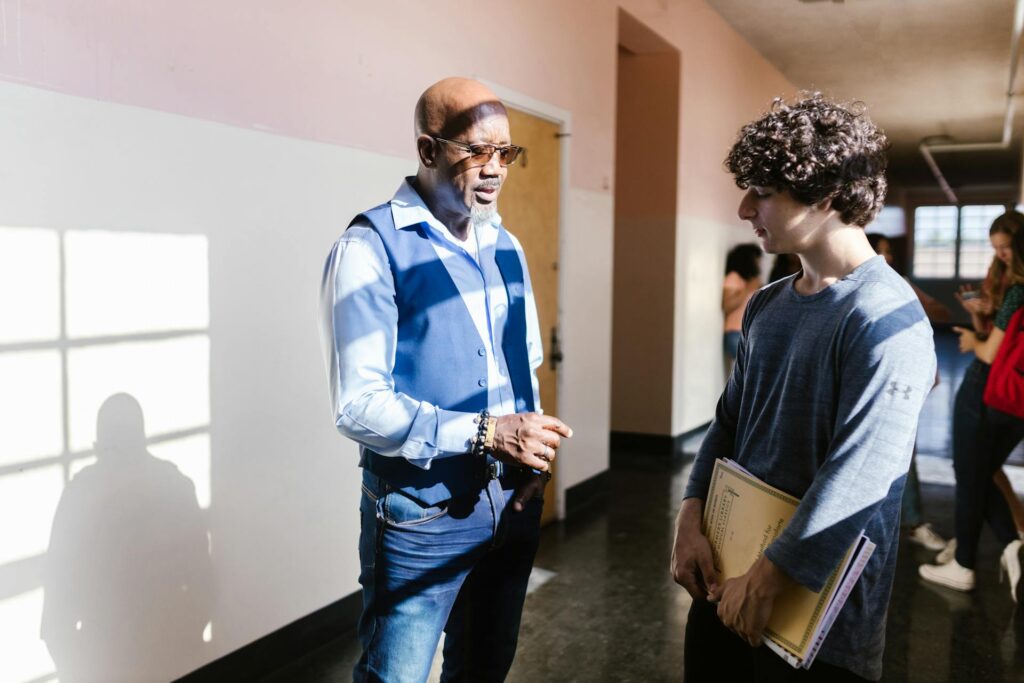
Teachers do not bite. Most of them actually love helping students who show effort. You do not need to become best friends, but you should become a familiar face.
Here is exactly what to say after class: “Hi Ms. Johnson, I really want to improve my grade in your class. Could you suggest one thing I should focus on this week?”
That simple question works magic. Teachers see hundreds of students who complain or give up. When you ask for specific help, you stand out. They remember you. They might offer extra credit, extensions, or study guides they do not give the whole class.
I remember a freshman named Kevin who failed his first two algebra quizzes. He stayed after school one day and asked his teacher, “What am I doing wrong?” The teacher showed him that Kevin kept mixing up negative signs in equations. That ten-minute conversation fixed his entire semester. He finished with a B-.
Do not wait until the end of the semester to introduce yourself. Go now. Today. Your teacher wants you to succeed.
Tip #4: Rethink Your Study Space and Schedule

Most students study in disaster zones. They lie on their bed, phone buzzing every thirty seconds, TV playing in the background, snack crumbs on their notebook. Then they wonder why nothing sticks.
Create a dedicated study spot. It does not need to be fancy. A desk in your room, a corner of the kitchen table, or even a library carrel works. The key is consistency. Your brain learns to focus when you sit in that same spot every day.
Next, build a daily study schedule. Start small. Commit to 45 minutes of focused work right after school. Take a ten-minute break. Then do another 45 minutes. That is only 1.5 hours. You can handle that.
One student, Taylor, had a 2.2 GPA as a sophomore. She studied in her bedroom with her phone next to her. She switched to studying at the public library for two hours every afternoon with her phone locked in her car. Her grades jumped to a 3.0 in one semester. No new tutor. No expensive program. Just a better environment and routine.
Tip #5: Use Summer and Winter Breaks Strategically

Low GPA from your freshman fall semester? You can erase or reduce the damage during breaks. Many schools offer:
- Credit recovery courses (online or in-person) to replace failing grades
- Summer school to retake a D or F
- Winter break enrichment to test out of a class you barely passed
Talk to your school counselor about grade forgiveness policies. Some schools let you retake a class and replace the old grade entirely. Others average the two grades. Either way, replacing an F with a C or B lifts your GPA significantly.
I worked with a student named Jamal who failed both semesters of geometry. His GPA sank to a 1.9. Instead of moving on to algebra II, he repeated geometry over the summer at a community college. He earned a B. The new grade replaced his Fs on his transcript. His GPA jumped to a 2.7 before junior year even started.
Do not waste your summers. One month of hard work can fix two semesters of struggle.
Tip #6: Don’t Ignore Extra Credit – But Don’t Beg For It Either

Extra credit exists. Use it, but use it wisely.
The wrong way: Waiting until the last week of the semester and begging your teacher, “Please, I’ll do anything for extra credit.” Teachers hate this. You had fifteen weeks to do the regular work. Now you want a shortcut?
The right way: Ask early. Say this: “Mr. Davis, I am working hard to raise my grade from a C to a B. Do you have any extra credit opportunities this month? I will do the work well and on time.”
Better yet, do not ask at all. Look at your syllabus. Many teachers list extra credit options from day one—attending an academic competition, writing a current events summary, or creating a study guide for the class. Do those things before you need them.
One student, Priya, earned a full letter grade boost in English simply by attending three after-school poetry readings. She signed up in September. Her grade never dropped below a B because she banked those points early.
Tip #7: Balance Your Course Load Next Semester

Sometimes your GPA suffers because you took on too much. Honors biology, AP history, advanced math, and a foreign language all in one semester? That schedule would challenge a college senior.
Look at your upcoming course registration form. Be honest with yourself. If your GPA is low because you struggle with heavy reading, drop one honors class and take the standard version. If you cannot memorize vocabulary, postpone that third year of a foreign language.
Dropping a class is not quitting. It is strategic. You preserve your mental energy for the classes that matter most.
I know a student named Carlos who insisted on taking four AP classes as a junior. His GPA from sophomore year sat at 2.5. He crashed hard—failed two AP classes and ended junior year with a 2.3.
The next year, he switched to three standard classes and one AP. He earned a 3.7 semester GPA. He later told me, “I wish I dropped those hard classes earlier. I was trying to prove something to nobody.”
Do not be Carlos. Choose your battles.
The Math of Recovery – How Many A’s Do You Really Need?
Let’s do simple math. Assume you finish your freshman year with a 2.0 GPA after 8 classes. You have 24 classes left over the next three years (8 classes per year). If you earn straight A’s (4.0) in every single class for the rest of high school, your final GPA becomes:
(8 classes × 2.0) + (24 classes × 4.0) = 16 + 96 = 112 total grade points. Divide by 32 total classes = 3.5 final GPA.
That is excellent. And you do not even need straight A’s. If you earn a mix of A’s and B’s (say 3.5 average for the remaining 24 classes), your final GPA lands around 3.1—still competitive for most colleges.
The point is this: One bad year does not kill your dreams. You just need to improve gradually. A 2.5 as a sophomore, then 3.0 as a junior, then 3.5 as a senior tells an amazing story of growth.
Mental Health Matters – Avoiding the Burnout Trap
Here is something nobody tells you: obsessing over your GPA can backfire. Students who panic-study often perform worse. They lose sleep, skip meals and cry over a single quiz. Then they burn out and give up.
Recovery requires balance. You need to:
- Sleep at least eight hours per night (all-nighters hurt your grades more than they help)
- Move your body—walk, stretch, play a sport
- Talk to a friend or family member about your stress
- Schedule one guilt-free fun activity each week (video games, movies, hanging out)
A student named Maya tried to raise her 2.4 GPA by studying four hours every night. She stopped seeing friends. She stopped exercising. By week six, she felt miserable and started skipping school. Her grades dropped further.
We changed her plan to 90 minutes of focused study plus 30 minutes of exercise daily. She also joined a weekend hiking group. Her mental health improved. Within two months, her grades rose to a 3.0. She learned that rest fuels success.
You cannot pour from an empty cup. Take care of yourself first. The grades will follow.
Summary: Recovering from a Low GPA Early in High School
A low GPA during your freshman or sophomore year does not ruin your future. Colleges love seeing an upward trend—starting low and finishing strong tells a powerful story of growth and resilience.
Key Steps to Turn Things Around:
- Know your starting point – Check your grades honestly. Use a GPA calculator to get your exact number.
- Own your grades without shame – Stop blaming teachers or bad luck. Say, “I control my effort from today forward.”
- Check grades weekly – Set a Friday alarm. Look for missing assignments, upcoming tests, and your lowest class.
- Talk to your teachers – Ask one simple question: “What should I focus on this week to improve?” Teachers love helping students who show up.
- Fix your study space and schedule – No phone, no bed, no TV. Study in the same quiet spot for 90 minutes daily.
- Use summer and winter breaks – Retake failed classes through credit recovery or summer school. One month of work can fix two semesters of struggle.
- Ask for extra credit early – Don’t beg at the end of the semester. Check the syllabus and complete extra work ahead of time.
- Balance your course load – Drop an honors or AP class if you’re overwhelmed. That’s not quitting—it’s being strategic.
- Do the math – A 2.0 GPA as a freshman can still become a 3.5 final GPA if you earn mostly A’s and B’s the rest of the way.
- Protect your mental health – Sleep 8 hours, exercise, and schedule fun. Burnout kills grades faster than anything else.
Real-Life Example:
A student named Jessica went from a 1.8 GPA as a freshman to a 3.4 GPA by senior year. She retook one class over the summer, started checking her grades weekly, and asked teachers for help. No magic—just consistency.
Bottom Line:
You have time. Start today. Open your grade portal, email one teacher, or clean off your desk. Three years from now, you’ll look back and feel proud of how far you’ve come.
“A low GPA early on doesn’t define you. Your comeback does.”
Conclusion: You’ve Got Time, So Start Today
A low GPA early in high school feels heavy. I get it. But here is the truth I have seen play out hundreds of times: students who recover from academic struggles often become the most successful adults. They learn resilience, humility and they learn how to ask for help.
You have already taken the first step by reading this article. Now take the second step. Open your grade portal. Write down your current GPA. Email one teacher. Clean off your desk. Do one thing today that moves you forward.
Not tomorrow. Not next week. Today.
Because three years from now, you will look back at this moment and feel proud. You will remember the semester you turned everything around. And you will walk across that graduation stage knowing you earned every single point.
Now go get to work. You have got this.
FAQs
How much does freshman year GPA really matter if I improve later?
While freshman year counts toward your cumulative GPA, colleges love a strong upward trend. A low 9th-grade GPA followed by As and Bs in 10th–11th grade shows resilience and growth, which often outweighs early struggles—especially for holistic admissions.
Can I raise my GPA from a 2.0 to a 3.5 by junior year?
Yes, but it requires strategic planning. If you have 2–3 semesters left, earning mostly As in honors or AP classes and retaking failed courses can significantly boost your GPA. Use a GPA calculator to map out realistic semester-by-semester targets.
What’s the best way to explain a low GPA due to COVID learning loss or mental health issues?
Address it briefly in your college application’s “additional information” section. Focus on what you learned (e.g., time management, seeking help) and highlight your recovery trajectory. Avoid excuses—show evidence of improved grades and stronger study habits afterward.
Does retaking a class replace my low grade or just average it?
It depends on your school’s policy. Many high schools use grade forgiveness (the new grade replaces the old one in GPA calculations), while others average the two. Check your student handbook or counselor. Even if grades are averaged, retaking shows initiative that colleges respect.
How do colleges view an upward trend in GPA after a rough start?
Extremely positively. Admissions officers look for an upward trend as proof of maturity and academic readiness. A student who went from a 2.5 to a 3.8 is often viewed more favorably than one with steady 3.4s. Emphasize your trend in essays and recommendation letters.