

Good attendance helps middle schoolers get better grades because every missed class means missed lessons — and in middle school, lessons build on each other. Miss one, and the next becomes harder to understand.
- More time in class = more learning and better test scores
- Consistent students develop stronger study habits naturally
- Teachers notice and offer more support to students who show up
- GPA drops noticeably even after just 9–10 missed days per year
Simply put — show up every day, and your grades will reflect it.
Middle school is one of the most important phases in a student’s academic journey. It is the bridge between elementary school and high school — and what happens during these years can shape a student’s entire future. One thing that many parents and students overlook is something surprisingly simple: showing up to school every single day.
Good attendance is not just about following rules. It is directly connected to better grades, stronger confidence, and long-term academic success. Research, teacher observations, and real student experiences all point to the same truth — students who attend school regularly perform significantly better than those who miss class frequently.
This article dives deep into why attendance matters so much in middle school, how it affects grades, and what families can do to make sure their child stays on the right track.
What Does “Good Attendance” Actually Mean?
Before going any further, it helps to define what good attendance really looks like. According to education experts, a student is considered “chronically absent” if they miss 10% or more of the school year. That means missing just 18 days out of a 180-day school year can put a student at serious academic risk.
Good attendance, on the other hand, means being present for at least 90% of school days — or missing no more than 9 days per year. That might not sound like a huge difference, but those extra days in the classroom add up to hours of instruction, practice, and learning that absent students simply miss.
A Healthy Routine built around consistent sleep, nutritious meals, and a set school schedule makes good attendance much easier to maintain. When students treat school attendance as a non-negotiable part of their day — just like brushing their teeth — it becomes second nature.
The Direct Link Between Attendance and Grades
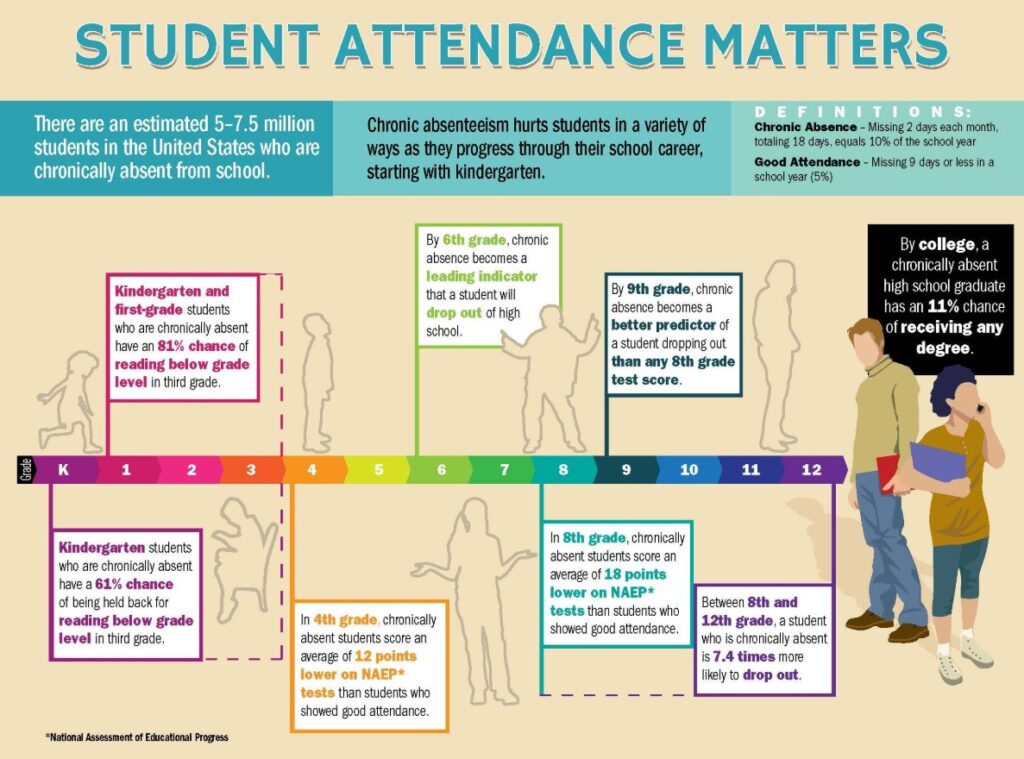
Here is something many students do not realize until it is too late: every missed class is a missed lesson. And in middle school, lessons build on top of each other. Miss one, and the next one becomes harder to understand.
Sarah, a 7th-grade teacher with over 12 years of classroom experience, explains it this way: “When a student misses a Monday class, they often spend the entire Tuesday trying to catch up instead of learning new material. By Wednesday, they are two lessons behind. That gap never fully closes for most kids.”
Studies support this observation. Research from the National Center for Education Statistics shows that students who attend school regularly are more likely to score higher on standardized tests, complete their assignments on time, and graduate with stronger academic records.
In practical terms, a student who attends 95% of school days tends to earn grades that are one full letter grade higher on average compared to a student who attends only 80% of the time. That is the difference between a B and a C — or a C and a D — in many core subjects.
How Missing School Affects Confidence and Participation
Grades are not the only thing that suffers when students skip school. Confidence takes a hit too.
Middle school classrooms are interactive environments. Students learn through discussions, group activities, lab experiments, and collaborative projects. When a student misses these experiences, they miss more than notes — they miss the social and intellectual engagement that makes learning stick.
Marcus, a 13-year-old 8th grader from Ohio, shared his experience: “I missed two weeks of school because of a bad flu. When I came back, everyone was working on a science project together, and I had no idea what was going on. I felt embarrassed to ask for help, so I just stayed quiet. My grade dropped from an A to a C that quarter.”
This experience is extremely common. Students who fall behind academically often start to feel disconnected from the classroom environment. They participate less, ask fewer questions, and slowly lose interest in school altogether. That disengagement is one of the biggest academic risks a middle schooler can face.
Staying Organized Becomes Harder When You Miss School

One of the underrated challenges of poor attendance is the chaos it creates in a student’s organizational life. Staying Organized is already a skill that most middle schoolers are still developing — and missing school makes it dramatically harder.
When a student is absent, they return to a pile of missed assignments, incomplete notes, and confused deadlines. Teachers may give extensions, but the student now has to juggle current work and make-up work at the same time. For a 12 or 13-year-old, that level of academic pressure can feel completely overwhelming.
Students who attend school consistently, however, always know what is due, what was discussed, and what to expect next. They walk into class prepared. They write down homework as it is assigned. They do not have to scramble to figure out what they missed. That organizational advantage directly contributes to better academic performance.
The Role of Attendance in Building Strong Study Habits and GPA Growth
There is a powerful connection between consistent attendance and the development of strong academic habits. Study Habits and GPA Growth go hand in hand — and both are rooted in regular school attendance.
When students show up every day, they naturally develop routines. They get used to absorbing information in structured settings, taking notes, asking questions, and reviewing material. These are not skills that come from textbooks. They are skills that develop through daily practice inside the classroom.
Over time, these habits translate directly into GPA improvement. A student who attends school consistently tends to:
- Complete more assignments on time
- Understand test material more deeply
- Participate in class discussions more confidently
- Build stronger relationships with teachers who can offer academic support
- Retain information longer due to repeated exposure
All of these factors combine to push GPA upward — semester after semester, year after year. The student does not have to be a genius. They just have to show up.
Attendance and Teacher Relationships

One aspect of good attendance that rarely gets enough attention is teacher relationships. When a student attends class every day, their teacher gets to know them as a learner. The teacher understands how the student thinks, where they struggle, and what motivates them.
This relationship is incredibly valuable. Teachers are far more likely to offer extra help, write strong recommendation letters, and advocate for a student they know and trust. Absent students, by contrast, are often invisible to their teachers — not out of neglect, but simply because the relationship never gets a chance to form.
Mrs. Alejandra Torres, a middle school math teacher with 15 years of experience, put it perfectly: “The students I remember most are the ones who were there every day. Not necessarily the smartest ones — but the ones who showed up, tried hard, and let me know them. Those are the kids I go the extra mile for.”
When a teacher goes the extra mile, grades often follow. Extra help during lunch breaks, clearer feedback on assignments, and a teacher who genuinely roots for a student can make a significant difference in academic performance.
How Peer Learning Depends on Regular Attendance
Middle school is not just about teacher-to-student learning. A huge portion of academic development happens peer to peer. Students explain concepts to each other, work through problems together, and motivate one another in ways that adults sometimes cannot.
Regular attendees benefit from this peer ecosystem every single day. They form study groups naturally. They understand inside jokes about class material. They share notes. They celebrate small academic wins together.
Students who miss school frequently are often excluded from this network — not intentionally, but practically. They were not there when the study group formed. They do not know what the big test is about because they missed the review session. That isolation compounds over time and makes academic recovery even harder.
The Pressure of Chronic Absence: Why It Gets Worse Over Time
Some families assume that a few missed days here and there will not have a lasting impact. But the evidence tells a different story. Pressure Affects Academic Performance in very real ways, and chronic absenteeism creates a specific kind of pressure that builds quietly until it becomes unmanageable.
Here is how it typically unfolds: A student misses a few days due to illness. They fall slightly behind. Instead of catching up fully, they get used to being a step behind. That discomfort of never quite understanding what is going on creates stress and anxiety. That anxiety makes the student less willing to attend school. And then the cycle deepens.
Dr. James Heckman, a Nobel Prize-winning economist who studied early education, found that school attendance patterns established in middle school can predict outcomes far into adulthood, including college attendance rates and lifetime earnings. The stakes are genuinely high — not to create fear, but to put the importance of daily attendance in the right perspective.
For students and families who want to track academic progress and understand exactly where things stand, tools like a GPA Calculator Middle School can be a helpful reality check. Seeing a GPA number drop from one semester to the next — correlated with months of inconsistent attendance — makes the connection undeniable.
Real Strategies Families Can Use to Improve Attendance
Understanding why attendance matters is only half the battle. The other half is doing something about it. Here are practical, experience-tested strategies that have helped real families improve their middle schooler’s attendance record.
1. Set a Consistent Morning Routine
Most attendance problems begin the night before. Late bedtimes lead to morning grogginess, which leads to missed buses and late arrivals. Setting a firm bedtime between 9:00 and 10:00 PM for middle schoolers ensures they wake up refreshed and ready.
2. Address Anxiety and Social Stress Early
Many middle schoolers who avoid school are not being lazy — they are dealing with social anxiety, bullying, or fear of failure. Parents should have open, non-judgmental conversations about what school feels like emotionally for their child. Sometimes a 10-minute talk prevents weeks of avoidance.
3. Treat School Like a Job
Families that frame school attendance the way adults frame workplace attendance tend to raise more consistent students. The message is simple: you go unless you physically cannot. That mindset builds resilience and reduces the temptation to skip for minor discomforts.
4. Communicate with Teachers Proactively
If a student does miss school, reaching out to the teacher immediately — rather than waiting — helps minimize the academic fallout. Most teachers appreciate a quick email explaining the absence and asking for missed materials. That proactive communication signals respect for learning.
5. Celebrate Attendance Milestones
Positive reinforcement works. When a student reaches a full month of perfect attendance, celebrating that achievement — even in small ways — reinforces the habit. Over time, those monthly milestones add up to full semesters and full years of consistent presence.
What Schools Are Doing to Support Attendance
Schools are increasingly aware of the attendance-grades connection, and many have implemented creative programs to support students. Attendance counselors, check-in/check-out programs, and family engagement initiatives are now common in many middle schools across the country.
Some schools have adopted attendance dashboards that alert parents when their child’s attendance drops below a certain threshold. Others have partnered with community health organizations to make sure that health-related absences are addressed quickly and effectively.
These school-level efforts work best when they are paired with strong family support at home. When parents and schools work together on attendance, students receive a consistent message from every direction: being present matters.
Long-Term Benefits of Strong Attendance Habits

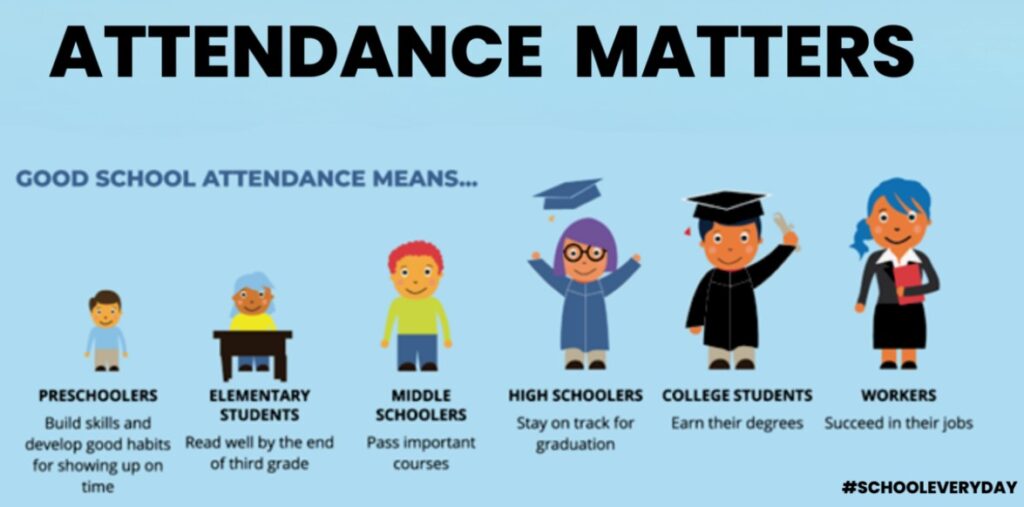
The benefits of good attendance do not stop when middle school ends. Students who build strong attendance habits in 6th, 7th, and 8th grade carry those habits into high school — where the academic stakes are even higher.
High school students with consistent attendance records are more likely to:
- Apply to and attend college
- Complete their degree programs on time
- Develop professional habits that employers value
- Earn higher salaries over the course of their careers
A Harvard study on noncognitive skills found that habits like punctuality, persistence, and reliability — all built through consistent school attendance — predicted career success more accurately than grades alone. Middle school attendance, then, is not just about grades. It is about building a version of a student who knows how to show up for life.
A Word to Middle Schoolers Directly
If a middle schooler is reading this, here is the truth in the plainest possible terms: school might not always be exciting, but it is always worth showing up for.
Every day spent in class is a day of building toward something. Every lesson absorbed, every question asked, every group project completed — these are not just school activities. They are investments in a future that is still being written.
The students who look back on their middle school years with pride are rarely the ones who found a way to avoid school. They are the ones who showed up, even when it was hard, even when they were tired, even when the subject was boring. Those students discovered something important: consistency is a superpower.
Summary
Good attendance in middle school directly leads to better grades. Every missed day means missed lessons, and since middle school topics build on each other, falling behind even slightly creates a snowball effect.
Key points:
- Missing 18+ days per year puts students at serious academic risk
- Regular attendees score one full letter grade higher on average
- Consistent attendance builds strong study habits, confidence, and teacher relationships
- Absent students struggle with organization, peer learning, and catching up
- Good attendance habits formed in middle school carry into high school, college, and career
Bottom line: Showing up every day is the simplest and most powerful thing a middle schooler can do to improve their grades and future outcomes.
Final Thoughts
Good attendance in middle school is one of the simplest, most powerful tools a student has for academic success. It does not require a tutor, a special program, or extraordinary intelligence. It requires showing up — day after day, with intention and commitment.
The research is clear. The teacher experiences confirm it. And the student stories make it real. When middle schoolers attend school consistently, their grades improve, their confidence grows, their relationships with teachers strengthen, and their long-term outcomes improve dramatically.
For parents, the message is equally clear: attendance is not a small thing. It is one of the most impactful choices a family makes every single morning. Building the habit early, addressing barriers honestly, and celebrating consistency can change the entire trajectory of a child’s academic life.
Show up. Every day. It is that simple — and that powerful.
FAQs
How does attendance affect grades in middle school?
Regular attendance means students never miss a lesson, stay caught up with assignments, and build stronger study habits — all of which directly push grades higher. Students who attend 90%+ of school days consistently earn better GPAs than those who are frequently absent.
How many absences are too many in middle school?
Missing 10 or more days per school year is considered a warning sign. Missing 18+ days (10% of the school year) officially classifies a student as chronically absent, which significantly increases the risk of failing grades and falling behind.
Can missing school lower your GPA in middle school?
Yes. Even 9–10 missed days can drop a student’s GPA by a noticeable amount. Each absence means missed instruction, incomplete notes, and make-up pressure — all of which hurt academic performance over time.
How can parents improve their child’s school attendance?
Parents can help by setting a consistent bedtime routine, addressing social anxiety early, treating school attendance like a non-negotiable daily responsibility, and communicating with teachers proactively whenever an absence does occur.
Why is middle school attendance more important than elementary school?
Middle school subjects are more complex and interconnected. Missing lessons in math, science, or English at this level creates knowledge gaps that are much harder to fill than in earlier grades — making consistent attendance critically important for long-term academic success.