
- Naming the feeling (tired, hungry, overwhelmed)
- Box breathing (4 seconds in, hold, out, hold)
- Creating small daily routines (morning, after-school, evening)
- Moving for 10 minutes (jumping jacks, dancing, walking)
- Eating balanced foods (bananas, oatmeal, eggs, yogurt)
- Sleeping 9–11 hours (no phone 1 hour before bed)
- Talking to a trusted adult (teacher, counselor, parent)
- Breaking big tasks into tiny steps (chunking)
- Using the Pomodoro method (25 min work, 5 min break)
- Writing down worries (brain dumping)
- Asking for professional help if stress lasts for weeks
Middle school can feel like a rollercoaster that never stops. One moment, everything seems fine. The next, a pop quiz, a friendship fight, or a forgotten homework assignment turns the whole world upside down. If you are a middle schooler reading this, please know you are not alone. Millions of students your age feel the exact same knot in their stomachs, the racing heart, and the endless worry.
Let’s talk about real ways to handle stress and anxiety. Not grown-up advice that sounds nice but doesn’t work. Real stuff that actual 12-year-olds, 13-year-olds, and 14-year-olds have tried and found helpful.
What Does Stress and Anxiety Actually Feel Like?
Meet Maya, a seventh grader from Texas. She describes her stress like this: “Before a math test, my hands get sweaty. I feel like I forgot everything I studied. Sometimes I want to just hide in the bathroom.”
Marcus, an eighth grader in Ohio, feels anxiety differently. “At night, I can’t sleep. My brain keeps replaying every awkward thing I said during the day. I worry about what my friends think of me.”
These feelings are real. They are not “just in your head” in a fake way. Stress and anxiety produce physical reactions. Your body releases cortisol and adrenaline. Your heart beats faster. Your muscles tense up. This is your body’s natural alarm system.
The good news? You can learn to calm that alarm system down. You can train your brain to respond differently.
Why Middle School Is So Stressful (And Why It’s Not Your Fault)
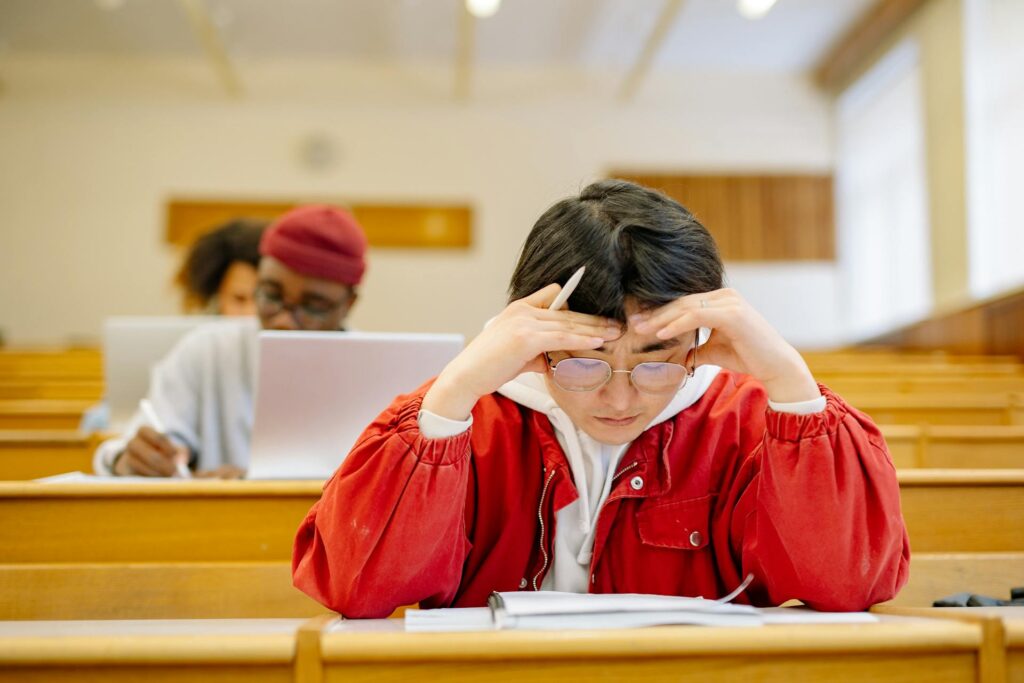
Middle school is a unique time. Your body is changing. Your brain is rewiring itself. You switch classrooms and teachers six or seven times a day. Social rules keep shifting. Grades start to matter more. And on top of all that, you are supposed to act like everything is fine.
Research shows that 70% of middle schoolers report feeling stressed about school regularly. That is not a small number. That is most of you.
Here is what makes middle school extra tough:
- More homework than elementary school
- Higher expectations from teachers and parents
- Social pressure to fit in and be liked
- Comparison culture from social media
- Less recess and physical activity
- Earlier mornings and more demanding schedules
None of this is your fault. You did not create this system. But you can learn to navigate it.
The First Step: Name What You Are Feeling
Before you can fix a problem, you have to know what it is. Many middle schoolers walk around feeling bad without understanding why.
Try this simple exercise. When you feel upset, ask yourself:
- Am I tired?
- Am I hungry?
- Am I overwhelmed by too many tasks?
- Am I scared about something specific?
- Am I angry about something that happened?
Elena, a sixth grader in Florida, started using a feelings chart on her phone. “I realized that what I called ‘anxiety’ was actually just me being really hungry and really tired at the same time. Once I ate a snack and rested, I felt way better.”
Naming your feeling takes away some of its power. You cannot fight a monster you cannot see. Give it a name. Then deal with it.
Breathe Like a Box (It Works Better Than You Think)
When adults tell you to “just breathe,” it can feel annoying. But hear me out. There is a specific way to breathe that actually calms your nervous system. It is called box breathing.
Here is how box breathing works:
- Breathe in slowly for 4 seconds
- Hold your breath for 4 seconds
- Breathe out slowly for 4 seconds
- Hold your lungs empty for 4 seconds
- Repeat 5 to 10 times
Kevin, a seventh grader who used to panic before presentations, tried box breathing. “I did it under my desk right before my social studies speech. My heart stopped racing. I could actually think clearly. I got a B+ and I was proud of myself.”
You can do this anywhere. In class. On the bus. Before a test. Nobody even has to know you are doing it.
Create a Tiny Routine That Saves Your Sanity
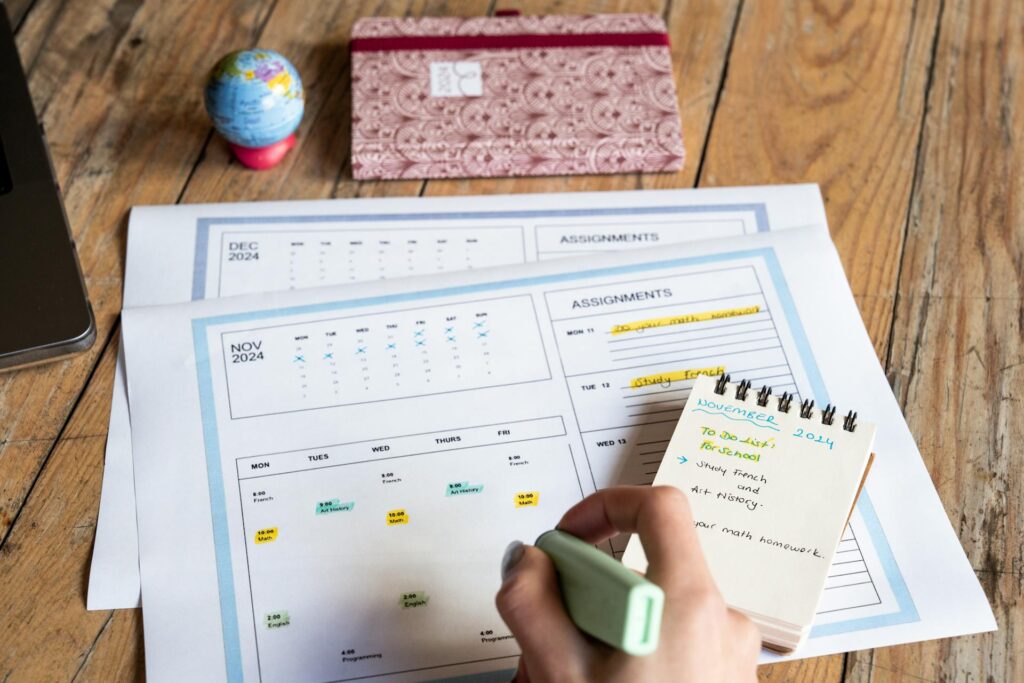
Your brain loves patterns. When you do the same small things every day, your brain feels safer. It does not have to work as hard to figure out what comes next.
You do not need a big complicated schedule. Start with three small anchors for your day:
Morning anchor: Every school morning, do the same three things in the same order. For example: brush teeth, eat breakfast, pack backpack.
After-school anchor: When you get home, do a 10-minute reset. Put your bag down. Wash your face. Drink water. Then look at what homework you have.
Evening anchor: Before bed, do a 15-minute wind-down. No screens. Brush your teeth. Read a book or listen to calm music. Then lights out.
Liam, an eighth grader in Colorado, said, “I used to stay up until midnight just worrying. Then I started a real bedtime routine. I turn off my phone at 9 PM. I read a graphic novel for 20 minutes. I fall asleep so much faster now.” Building a consistent routine is one of the most powerful tools for academic success.
Move Your Body for 10 Minutes (Yes, Even When You Are Tired)
Your body stores stress in your muscles. If you never move, that stress just sits there. It builds up. It makes you feel worse.
You do not need to join a sports team or run a mile. You just need to move.
Try one of these for 10 minutes:
- Jumping jacks in your room
- Dancing to your favorite song
- Walking around your neighborhood
- Stretching on your bedroom floor
- Doing 10 push-ups and 10 squats
Zoe, a sixth grader who struggled with anxiety, said, “When I feel the freak-out coming, I go outside and run around my house three times. It sounds weird, but it works. The physical feeling of running uses up all that nervous energy.”
Movement changes your brain chemistry. It releases endorphins, which are natural mood lifters. You cannot think your way out of stress if your body is screaming. Move first. Then think.
Eat Foods That Help Your Brain Calm Down

What you eat affects how you feel. Sugar and processed snacks give you a quick burst of energy, but then you crash. That crash feels a lot like anxiety — shaky, irritable, and foggy.
Some foods actually help your brain produce calming chemicals. Think about adding more of these:
- Bananas (natural magnesium)
- Oatmeal (steady energy release)
- Eggs (protein and B vitamins)
- Yogurt (gut health affects mood)
- Dark leafy greens (folate)
Carlos, a seventh grader, noticed a huge shift. “I used to eat chips and a soda for lunch. By fifth period, I felt jittery and angry. I switched to a sandwich and an apple. Now I feel normal all afternoon. It was unbelievable how big the change was.”
Sleep Is Not Optional — It Is Your Superpower
Most middle schoolers need 9 to 11 hours of sleep. Most get 7 or less. That missing sleep does not just make you tired. It makes you more anxious, more irritable, and worse at handling stress.
When you are sleep-deprived, your amygdala (the fear center of your brain) goes into overdrive. Small problems feel like huge disasters. A lost pencil feels like the end of the world.
Here is how to fix your sleep:
- Put your phone away 1 hour before bed
- Keep your room cool and dark
- Go to bed at the same time every night (even weekends)
- Do not do homework in bed — your brain should see bed as a sleep zone only
Sophia, an eighth grader, used to stay up until 11:30 PM on her phone. “I was exhausted every single day. My grades dropped. My mom took my phone at 9 PM and I was so mad. But after two weeks, I felt like a different person. I had energy. I stopped crying over little things.” Sleep is not wasting time. Sleep is when your brain cleans itself and processes emotions.
Talk to Someone Who Gets It
You do not have to carry your stress alone. In fact, carrying it alone makes it heavier.
Find one trusted person you can talk to. This could be:
- A parent or guardian
- A favorite teacher
- A school counselor
- An older sibling
- A friend who is a good listener
Jayden, a seventh grader, said, “I thought telling someone about my anxiety would make me look weak. But when I finally told my school counselor, she just nodded and said ‘lots of kids feel that way.’ She gave me a pass to take a break in her office whenever I needed it. That pass saved me so many times.”
If you do not have a trusted adult at school, that is hard. But you can find one. Keep trying different teachers until someone listens. Most teachers became teachers because they care about kids. Give them a chance to help.
Break Big Tasks into Tiny Pieces
A huge amount of middle school anxiety comes from feeling overwhelmed by assignments. Your teacher says “write a five-paragraph essay due Friday.” Your brain hears “climb Mount Everest in flip-flops.”
The trick is chunking. Break the big scary task into very small steps.
For a five-paragraph essay, your steps could be:
- Pick a topic (5 minutes)
- Write one sentence for each paragraph (10 minutes)
- Write the first paragraph (15 minutes)
- Take a break (5 minutes)
- Write the second paragraph (15 minutes)
- And so on…
Mia, a sixth grader, used to cry before starting homework. “It all looked impossible. Then my dad helped me make a list of tiny steps. ‘Just open your notebook’ was the first step. Then ‘read the first question.’ Each step was so small that I could do it. And after doing ten tiny steps, the homework was done.” Procrastination often comes from feeling overwhelmed.
Give Yourself a Break (Literally)

You cannot focus for hours straight. Nobody can. Your brain needs rest just like your muscles do.
Try the Pomodoro method:
- Work hard for 25 minutes
- Take a 5-minute break
- Repeat 4 times
- Then take a 15-minute break
During your 5-minute breaks, do not scroll on your phone. That does not actually rest your brain. Instead:
- Stand up and stretch
- Close your eyes for a minute
- Get a drink of water
- Look out the window
- Do 10 jumping jacks
Noah, an eighth grader, said, “I used to try to do all my homework in one painful block. By the end, I was crying over easy questions. Now I set a timer. I work for 25 minutes, then I play with my dog for 5 minutes. I finish faster and I feel so much better.”
Write Down the Worry and Lock It Away
Your brain has something called working memory. It can only hold a few thoughts at once. When you have a worry, it takes up space. It pushes out other thoughts. You cannot focus on math if your brain is busy replaying an embarrassing moment.
The solution is brain dumping. Get a notebook or a piece of paper. Write down every worry in your head. Do not judge it. Do not try to solve it. Just write it.
Isabella, a seventh grader, fills one page every night before bed. “I write things like ‘I hope I didn’t sound weird in science class’ and ‘I have a quiz tomorrow I forgot to study for.’ Once it is on paper, my brain lets it go. I sleep so much better.”
After you write your worries, you can shut the notebook and put it away. That is a physical signal to your brain that you are done thinking about those things for now.
Know That Anxiety Lies to You
Anxiety tells you scary stories that are not true. It says:
- “Everyone hates you” (not true — one person was mildly annoyed)
- “You are going to fail this test” (not true — you studied more than you think)
- “Something terrible will happen” (not true — you just feel on edge)
When you feel anxious, ask yourself: What is the evidence? Is there actual proof that your fear will come true? Or is your anxiety just making stuff up?
Oliver, a sixth grader, was terrified to raise his hand in class. His anxiety told him he would say something foolish and everyone would laugh. One day, he forced himself to answer an easy question. Nobody laughed. The teacher said “good job.” Oliver realized his anxiety had been lying to him for months.
Learning to recognize anxiety’s lies is a skill. It takes practice. But you can get better at it.
Why Managing Mental Health Early Changes Everything
Here is something most adults wish they had learned in middle school: how you handle stress now shapes how you handle stress for the rest of your life.
If you learn healthy coping skills at 12 or 13 years old, you carry those skills into high school, college, and your job. You save yourself years of struggle.
Ethan, a high school senior looking back, said, “I had panic attacks in middle school and I thought I was broken. But I learned breathing techniques and how to ask for help. Now in high school, when things get hard, I have tools. My friends who never learned coping skills are falling apart. I feel bad for them, but I am glad I learned early.”
The earlier you start practicing mental health habits, the more natural they become.
Surviving Midterms and Finals Without Losing Your Mind

Test weeks are the worst. Everything piles up at once. Teachers all decide to have exams in the same three days. You feel like you are drowning.
Here is a survival plan for exam week:
- Start studying one week early — just 20 minutes a day
- Sleep at least 8 hours the night before each test
- Eat a real breakfast with protein (not just a granola bar)
- Arrive early so you are not rushing
- Read all directions twice before starting
- If you freeze up, do box breathing for 30 seconds
Ava, an eighth grader, used to get sick before finals. “My stomach would hurt so bad. Then I started a finals routine. I made flash cards a week ahead. I asked my mom to quiz me. The night before, I watched a funny show to calm down. My grades went up a whole letter grade just because I was less scared.”
The Connection Between Mental Health and Grades
Here is something schools do not always tell you: your mental health directly affects your grades.
When you are anxious, you cannot focus. When you cannot focus, you do not learn. When you do not learn, you get lower grades. Lower grades make you more anxious. It is a cycle.
Breaking the cycle means treating the anxiety, not just trying to study harder.
Daniel, a seventh grader, was getting Cs and Ds. His parents thought he was lazy. But Daniel was exhausted from worrying all the time. After he started seeing a therapist and using breathing techniques, his grades went up to Bs and As without him studying any more than before. He just had more brain space available for learning.
Your brain can only do so many things at once. If a big chunk of your brain power is being used for worry, you have less left for algebra and reading comprehension. Taking care of your mental health is not separate from academics. It is academics.
When to Ask for Professional Help
Sometimes, stress and anxiety are too big to handle on your own. That is not a failure. That is like saying a broken bone is too big to heal without a doctor.
You should talk to an adult about getting professional help if:
- You feel sad or worried almost every day for weeks
- You have trouble sleeping most nights
- You have lost interest in things you used to enjoy
- You have thoughts of hurting yourself
- Your stomach hurts or you feel sick before school every day
A therapist or counselor can teach you personalized tools. They can also help you figure out if there is something deeper going on, like an anxiety disorder or depression.
Maria, a 13-year-old, was embarrassed to start therapy. “I thought only ‘wild’ people went to therapy. But my therapist is just a nice lady who plays board games with me and teaches me tricks to calm down. It is not scary at all. I wish I had started sooner.”
Summary
The post explains that stress and anxiety are normal in middle school due to changing bodies, more homework, social pressure, and less recess. It shares real experiences from students like Maya, Kevin, Zoe, and Liam to show practical coping strategies.
Key strategies covered:
- Name your feeling (tired, hungry, overwhelmed) to reduce its power.
- Box breathing (4‑4‑4‑4 seconds) to calm your nervous system.
- Build tiny daily routines (morning, after‑school, evening) for safety and predictability.
- Move your body for 10 minutes (jumping jacks, dancing, walking) to release endorphins.
- Eat brain‑calming foods (bananas, oatmeal, eggs, yogurt) instead of sugary snacks.
- Prioritize sleep (9‑11 hours) – sleep deprivation makes anxiety worse.
- Talk to a trusted adult (teacher, counselor, parent) – you don’t have to carry stress alone.
- Break big tasks into tiny pieces (chunking) to avoid feeling overwhelmed.
- Use the Pomodoro method (25 min work / 5 min break) to stay focused.
- Write down worries (brain dumping) to clear your working memory.
- Recognize that anxiety lies – ask “What is the evidence?”
- Seek professional help if sadness, worry, or physical symptoms last for weeks.
A Final Word: You Will Not Feel Like This Forever
When you are in the middle of a stressful moment, it feels like it will never end. That is how anxiety tricks you. It makes the present moment feel permanent.
But feelings are not permanent. They pass. The wave of anxiety rises, peaks, and then falls. You just have to ride it out.
Every single adult who reads this post remembers being a stressed-out middle schooler. They remember the sweaty palms, the racing thoughts, the sleepless nights. And they survived. You will too.
You are not broken. You are not weak. You are a normal middle schooler in a system that asks a lot of you. And you are already taking a huge step just by reading this and looking for answers.
Pick one strategy from this post. Just one. Try it tomorrow. See what happens. Then try another one. Small steps add up to big changes.
FAQs
Why do I feel so stressed and anxious in middle school?
You feel stressed because middle school brings big changes all at once. You switch 6 or 7 classes a day, deal with more homework, face social pressure from friends, and your body is growing. Your brain releases cortisol and adrenaline when you feel overwhelmed. That racing heart and sweaty palms are your body’s alarm system. The good news? You can learn to calm it with box breathing, small routines, and talking to someone you trust.
How can I calm down right before a test?
Try box breathing. Breathe in for 4 seconds, hold for 4 seconds, breathe out for 4 seconds, hold for 4 seconds. Repeat 5 times. Do this quietly under your desk. Another trick: name what you feel – “I am nervous because I want to do well.” Then take 10 seconds to stretch your fingers or roll your shoulders. Many students like Kevin did this before a speech and felt much calmer.
What foods help reduce anxiety in middle schoolers?
Foods that give steady energy and brain-calming nutrients work best. Try bananas (magnesium), oatmeal (slow release energy), eggs (protein and B vitamins), yogurt (gut health), and dark leafy greens (folate). Avoid sugary snacks and soda – they cause a crash that feels like anxiety. Small changes in what you eat can change how you feel by 3 PM.
How many hours of sleep do middle schoolers need to lower anxiety?
Most middle schoolers need 9 to 11 hours of sleep each night. When you sleep less than 8 hours, your amygdala (the fear center of your brain) becomes overactive. Small problems feel huge. To sleep better: put your phone away 1 hour before bed, keep your room cool and dark, and go to bed at the same time every night. Sleep is not wasting time – it is when your brain cleans itself and processes emotions.
When should a middle schooler ask for professional help for anxiety?
You should ask a trusted adult for professional help if you feel sad or worried almost every day for weeks, have trouble sleeping most nights, lose interest in things you used to love, feel stomach pain or sickness before school every day, have thoughts of hurting yourself, find that anxiety stops you from doing normal things like going to class or hanging with friends, or have tried breathing, routines, and talking to someone but nothing seems to help. Seeing a therapist is not scary. It is like having a coach for your feelings. Many students say they wish they had started sooner. Learning to manage mental health early changes everything for the rest of your life.