

- Wake at the same time daily (even weekends). Drink water. Get sunlight. Make your bed. No phone for first 30 minutes.
- Eat protein breakfast (eggs, yogurt, oatmeal). Keep healthy snacks.
- Study in 25–50 minute focused blocks with 5–10 minute breaks (Pomodoro).
- Move every hour – a 5-minute walk boosts brain flow by 15%.
- Beat procrastination with the “5-minute rule” (just start for 5 minutes).
- No screens 60 minutes before bed. Sleep 8–9 hours in a cool, dark room.
- Start with one small change for 7 days, then add another.
You know the scene. Your phone screams at 7:00 AM. You slap the snooze button. Once. Twice. Three times. Next thing you know, it is 7:45 AM and you have 15 minutes to get to class. You skip breakfast, grab an old energy drink from the fridge, and run out the door with mismatched socks.
By 10:00 AM, your head is pounding and by 2:00 PM, you cannot focus on a single sentence in your textbook. By 9:00 PM, you are staring at a blank screen, wondering where the day went.
This was Jake last semester. A college sophomore who felt like he was drowning in assignments, caffeine, and guilt. He thought success meant studying longer and sleeping less. He was wrong.
Then Jake built a healthy daily routine. Not a rigid, military-style schedule. A flexible, realistic rhythm that worked with his real life – not against it. His grades went from C’s to B+’s. His anxiety dropped. And for the first time in years, he actually enjoyed being a student.
You can do the same. This guide walks you through exactly how – using real student stories, simple language, and science that actually makes sense. No fluff. No perfect Instagram morning routines. Just what works.
1. The Morning Blueprint
Let us talk about mornings. Not the 5:00 AM cold plunge nonsense. Real mornings for real students.
Meet Chloe. Chloe is a high school senior. She used to wake at different times every day – 6:30 AM on weekdays, 10:00 AM on weekends. Her body was constantly confused. She felt tired even after sleeping 9 hours. Then she tried something simple: waking at the same exact time every single day – including Saturdays and Sundays. She picked 7:00 AM.
Within two weeks, something magical happened. Chloe started waking up naturally at 6:55 AM without an alarm. Her energy levels became predictable. No more groggy mornings. No more afternoon crashes.
Here is your 30-minute morning blueprint (no gym required):
Minute 0–5: Wake and hydrate – Keep a water bottle on your nightstand. Drink 16–20 ounces before you even sit up. Your body is 75% water. After 7–8 hours of sleep, you are running on empty.
Minute 5–10: Get sunlight – Open your blinds or step outside for 5 minutes. Sunlight enters your eyes and tells your brain to stop producing melatonin (the sleep hormone). This is free, zero-effort energy. Even on cloudy days, outdoor light is 100 times brighter than indoor lights.
Minute 10–15: Move your body – Do not call it a workout. Just stretch your arms, roll your neck, do 10 standing toe touches, or walk one lap around your room. This wakes up your circulation. Five minutes is plenty.
Minute 15–20: Make your bed – This takes two minutes. But Admiral William McRaven (former Navy SEAL) says it is the first task of the day. Complete it, and you have already won a small victory. That momentum carries forward.
Minute 20–30: No phone zone – Keep your phone across the room. Do not touch it for the first 30 minutes of your day. Chloe used to check TikTok immediately. She lost 45 minutes every morning before brushing her teeth. Now she uses that time to eat breakfast calmly. Her anxiety dropped by half.
When parents ask how to help younger students build these habits, experts often recommend starting with healthy routines for middle school academic success – the same principles apply: fixed wake time, sunlight, and no screens first thing.
2. Breakfast and Brain Fuel
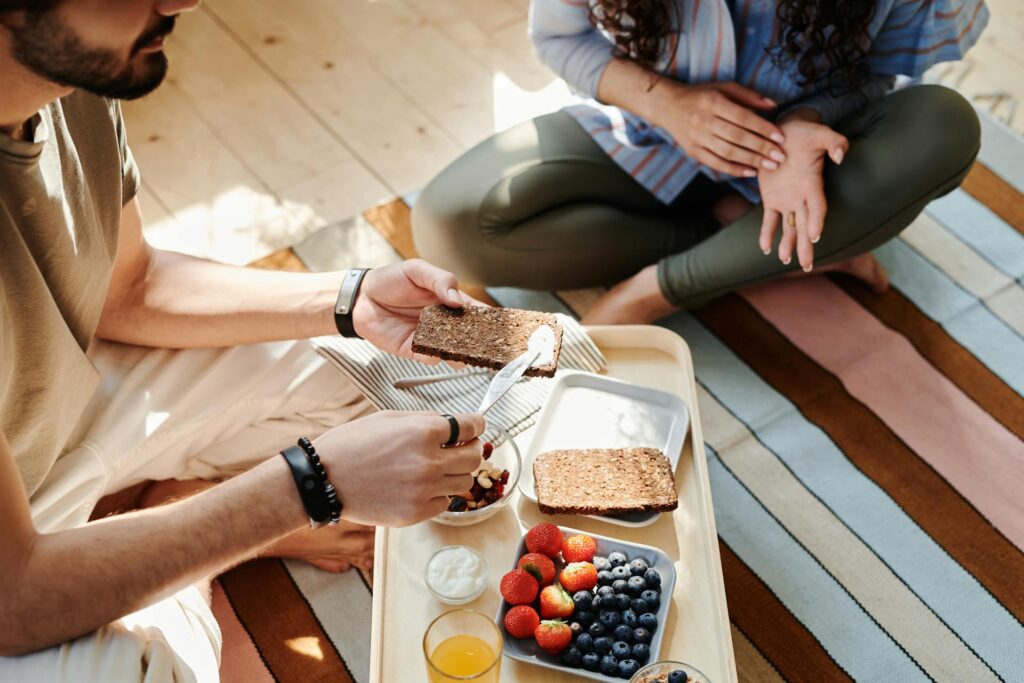
Here is a hard truth: breakfast is not optional. But most students eat breakfast wrong.
What wrong looks like: A sugary cereal bar, a donut from the campus shop, or a giant iced coffee with flavored syrup. These give you a quick glucose spike followed by a massive crash around 10:30 AM. Your hands shake. Your brain feels fuzzy. You cannot remember what the professor said 15 minutes ago.
What right looks like: Protein, healthy fats, and complex carbs. These digest slowly, giving your brain steady energy for 3–4 hours.
Marcus, a junior in college, used to skip breakfast entirely. He said, “I am just not hungry in the morning.” By 11:00 AM, he was shaking and irritable. He would eat a giant, greasy lunch – then feel lethargic all afternoon. A friend suggested a tiny breakfast: half a cup of Greek yogurt with a handful of blueberries. Marcus tried it. Within three days, his morning shakes disappeared. By 11:00 AM, he was still focused. His lunch portions shrank naturally because he was not ravenous.
Quick, under-5-minute breakfasts for students:
- Greek yogurt (plain, 15–20g protein) + handful of walnuts + drizzle of honey
- Peanut butter on whole-grain toast + sliced banana on top
- Overnight oats – mix 1/2 cup oats, 1/2 cup milk, 1 tbsp chia seeds, 1 tsp maple syrup in a jar. Refrigerate overnight. Grab and go.
- Two hard-boiled eggs (boil 6 on Sunday) + one apple
- Protein smoothie – 1 scoop protein powder, 1 cup spinach, 1/2 banana, 1 cup almond milk. Blend in 60 seconds.
For a complete list of brain-boosting meals that students actually like, check out the 10 best foods for students – this guide saved Marcus from his ramen-and-coffee diet.
What about snacks? Keep emergency snacks in your backpack. A handful of almonds, a cheese stick, a small apple. When you have a 30-minute gap between classes and your blood sugar drops, these prevent the vending machine disaster (chips + candy = crash + regret).
3. Build a Study Schedule
Let me tell you about Sophia. Sophia is a pre-med student. She used to “study” for 8 hours on Saturdays. She would sit at her desk from 9:00 AM to 5:00 PM with one break for lunch. But here is the truth: she only actually studied for about 3 of those hours. The other 5 hours were a blur of phone scrolling, staring at walls, and re-reading the same paragraph seven times.
Sophia felt guilty. She thought she was lazy. But she was not lazy. She was ignoring how the human brain actually focuses.
The science: Your brain works in ultradian rhythms. You can maintain high focus for about 45–90 minutes. After that, attention drops by as much as 40%. Pushing past this limit is like running a car on empty – you are not going anywhere, but you are burning fuel.
The solution: The Pomodoro Technique. Work for 25 minutes, break for 5 minutes. After four cycles (about 2 hours), take a longer break of 15–30 minutes.
Sophia tried this. She set a timer for 25 minutes and told herself, “I only have to focus for 25 minutes. Anyone can do 25 minutes.” Then she took a 5-minute break – walked to the kitchen, stretched, looked out the window. After four cycles, she took a 30-minute lunch break away from her desk.
The result? In 3 hours of Pomodoro study, Sophia accomplished more than she used to in 8 hours of fake studying. Her grades improved. And she stopped feeling guilty.
How to schedule your study blocks:
Step 1: Identify your peak focus hours. Are you a morning person (sharpest 7:00–10:00 AM) or an evening person (sharpest 7:00–10:00 PM)? Schedule your hardest subjects during these 90-minute windows.
Step 2: Plan the night before. Write down: “8:00–8:25 AM – Math problems (25 min). 8:30–8:55 AM – Read history chapter. 9:00–9:25 AM – Outline essay.” When you wake up, you do not waste energy deciding what to do.
Step 3: Use the “2-minute rule.” If a task takes less than 2 minutes (reply to an email, write down a homework deadline, put away your laundry), do it immediately. This stops tiny tasks from piling into a mountain.
Step 4: Take real breaks. Do not check social media during your 5-minute break. Social media keeps your brain active. Instead, stand up, walk, stretch, close your eyes, or drink water. Your brain needs true rest to recharge.
One more thing: do not study in bed. Your brain associates bed with sleep. When you study in bed, you confuse your brain. And when you try to sleep later, your brain thinks, “Should I be solving math problems right now?” Keep your bed for sleeping. Keep your desk for studying.
4. Movement and Micro-Breaks

Ethan was a senior who spent 6+ hours sitting every day – in class, at the library, on the couch. His back hurt constantly. His neck was stiff. And he noticed something strange: his memory felt worse than it did in high school.
Then he took a kinesiology class and learned something shocking. Sitting for long periods slows blood flow to your brain by up to 15%. Less blood flow means less oxygen. Less oxygen means worse memory, slower thinking, and lower mood.
But here is the good news: tiny movements reverse this almost instantly. A 5-minute walk increases blood flow to your brain by 15%. A 1-minute stretch relaxes tight muscles. 10 jumping jacks wake up your entire nervous system.
Ethan started setting a timer for every 50 minutes. When it went off, he stood up and did something physical for 5 minutes – walked a lap around the library, stretched his arms overhead, touched his toes, or did 10 squats. Within two weeks, his back pain disappeared. He felt sharper. And his exam scores went up by one full letter grade.
Easy movement ideas for students:
- Walk to a water fountain even if you are not thirsty
- Do desk stretches – roll your shoulders, tilt your neck side to side, stretch your wrists
- Take the stairs instead of the elevator (even 2 flights helps)
- Dance to one song in your room – seriously, it works
- Set a “standing rule” – stand during phone calls or while watching lecture recordings
Do not skip lunch breaks away from your desk. Eating while studying does not count as a break. Your brain needs true disengagement. Sit somewhere else. Look out a window. Talk to a friend. This 20-minute reset makes your afternoon study session twice as effective.
You might wonder: “Does movement really affect my grades that much?” The answer is yes. Research shows that students who take regular movement breaks have better recall and lower stress. Learning about the importance of sleep for better grades also opened Ethan’s eyes – he realized that his afternoon walks helped him fall asleep 30 minutes faster because his body was properly tired.
5. Procrastination
Let us talk about the elephant in the room. Procrastination.
You have a paper due in three days. You know you should start. But instead, you watch 45 minutes of YouTube videos about how to organize your closet. Then you clean your desk and you scroll Instagram. Then you take a “quick nap.” Suddenly, it is 11:00 PM and you have written zero words.
You feel guilty. You call yourself lazy. But here is the truth: procrastination is not laziness. It is emotional avoidance.
Dr. Tim Pychyl, a procrastination researcher, explains that we put off tasks because they feel boring, difficult, frustrating, or scary. Your brain wants to escape that negative feeling. So it chooses something that feels good in the moment – even if that thing is objectively boring (like watching unboxing videos for 2 hours).
Meet Olivia. Olivia is a graduate student who struggled with procrastination for years. She would wait until the last possible minute to start every assignment. The stress was unbearable, but she could not break the cycle.
Then she learned the “5-minute rule.” Here is how it works: promise yourself you will work on the task for just 5 minutes. After 5 minutes, you can stop. No guilt. No pressure.
Olivia tried this on a literature review she had been avoiding for two weeks. She set a timer for 5 minutes and opened her laptop. She told herself, “I only have to write for 5 minutes. Then I can watch Netflix.” After 5 minutes, she thought, “Well, that was not so bad. Let me do 5 more.” She ended up writing for 90 minutes and finished the first draft.
The hardest part of any task is starting. The 5-minute rule tricks your brain into lowering the emotional wall.
Other anti-procrastination strategies that work:
- Break tasks into micro-steps. Instead of “write research paper,” write “open laptop,” then “create document,” then “write three sentences.” Each micro-step feels easy.
- Use a visual timer. Set a physical timer for 10 minutes and place it where you can see it. Watching the time decrease creates healthy pressure.
- Remove friction. Put your phone in another room. Use a website blocker like Freedom or Cold Turkey. Close your door. Tell your roommate, “Do not let me leave this room for 30 minutes.”
- Schedule your procrastination. Yes, really. Block 30–60 minutes each day for guilt-free scrolling, gaming, or watching shows. When your brain knows it will get a reward later, it is easier to focus now.
- Name the emotion. Ask yourself, “What feeling am I avoiding?” Boredom? Fear of failure? Confusion? Just naming the emotion reduces its power.
For deeper, step-by-step methods that actually work for overwhelmed students, avoid procrastination and stay on track – this resource helped Olivia cut her procrastination time by more than half within one month.
6. Healthy Sleep

Now we get to the most underrated part of any healthy routine: sleep.
Most students treat sleep as optional. They brag about all-nighters. They say, “I will sleep when I am dead.” But here is the brutal truth: sleep deprivation destroys your grades more than anything else.
Here is what happens when you sleep: Your brain consolidates memories (moves what you learned from short-term to long-term storage). It clears out toxins (including beta-amyloid, a protein linked to brain fog). It recharges your emotional batteries (so you do not snap at your roommate over dirty dishes).
Pull an all-nighter? You lose up to 40% of what you studied. That means 4 hours of cramming yields the same result as 2.4 hours of studying with good sleep. You are literally wasting your time.
Meet Kevin. Kevin was a first-year engineering student who thought sleep was for the weak. He slept 5 hours per night, drank four cups of coffee daily, and felt proud of his “grind.” His grades were mediocre – C+ average. He felt anxious all the time. His memory was spotty.
His roommate challenged him: “Try 8 hours of sleep for one week. Just one week.” Kevin agreed reluctantly. He went to bed at 10:00 PM and woke at 6:00 AM for seven days.
The result shocked him. He finished homework 30% faster because he was not re-reading everything and also he remembered lecture details without reviewing. He stopped snapping at people. His next exam score was an A-. Kevin never went back to 5 hours again.
How to build a student-friendly evening routine:
Step 1: Pick a bedtime and stick to it (even weekends). Your brain craves consistency. Going to bed at 11:00 PM on weekdays and 2:00 AM on weekends is like flying from New York to London every week – you give yourself jet lag constantly.
Step 2: Stop screens 60 minutes before bed. The blue light from phones, laptops, and TVs suppresses melatonin (your sleep hormone) by up to 50%. Instead, read a physical book, listen to calm music, stretch, or talk to a family member.
Step 3: Create a 10-minute “shut-down” ritual. Write tomorrow’s to-do list (this gets worries out of your head). Brush your teeth. Wash your face. Change into pajamas. Dim the lights. These repeated actions tell your brain: “Sleep is coming.”
Step 4: Keep your room cool and dark. The ideal sleeping temperature is 65–68°F (18–20°C). Use blackout curtains or an eye mask. Wear earplugs if your dorm is noisy.
Step 5: Cut caffeine by 2:00 PM. Caffeine has a 6–8 hour half-life. That 4:00 PM iced coffee means 25% of it is still in your system at 10:00 PM. You might fall asleep, but your sleep quality will be terrible.
Kevin now follows this routine 90% of the time. He still stays up late before finals, but his baseline is solid. His GPA went from 2.7 to 3.4 in two semesters. No extra studying – just better sleep.
When Kevin started sleeping well, he noticed his mood and motivation improved dramatically. He later read about the deep connection between rest and emotional balance in a guide on mental health and academic success – and realized that his old “grind until 2 AM” habit was actually making him depressed and anxious.
7. A Realistic Sample Daily Routine
You do not need to follow this exactly. It is a template, not a prison schedule. Adjust times based on your class schedule and chronotype (morning lark or night owl).
For a morning person (wakes at 6:30 AM):
- 6:30 AM – Wake (same time every day). Drink 16 oz water. Open blinds.
- 6:35 AM – Light stretch or walk around room. Make bed.
- 6:45 AM – Shower, get dressed.
- 7:00 AM – Breakfast with protein (eggs, yogurt, or overnight oats).
- 7:30 AM – Pack bag, review today’s schedule.
- 8:00 AM – 12:00 PM – Classes or Pomodoro study blocks (45 min work / 5 min break).
- 12:00 PM – Lunch away from desk. 20 minutes real rest.
- 1:00 PM – 4:00 PM – Afternoon classes or lighter study tasks. One 10-minute walk outside.
- 4:00 PM – Snack (almonds, apple, cheese). One more 45-minute study block.
- 5:00 PM – Exercise or movement (20–30 minutes – walk, gym, dance).
- 6:00 PM – Dinner with friends or family. No screens.
- 7:00 PM – 9:00 PM – Social time, hobbies, relaxation. Finish small tasks.
- 9:00 PM – Start wind-down. Put phone away. Write tomorrow’s to-do list.
- 9:30 PM – Shower, brush teeth, dim lights, read paper book.
- 10:00 PM – In bed. Lights off. 8.5 hours of sleep.
For a night owl (wakes at 8:00 AM, sleeps at 12:00 AM): Shift everything 1.5 hours later. The sequence matters more than the exact clock time.
How to Make Your Routine Stick Forever
You have read 2,500+ words of advice. Now comes the hardest part: actually doing it.
Most people read guides like this, feel inspired, try to change everything on Monday, fail by Wednesday, and go back to old habits. Do not be most people.
The one-week challenge:
- Week 1: Pick one thing. Just one. Drink water before coffee. Or make your bed. Or take a 5-minute walk between classes. Do it every day for 7 days.
- Week 2: Add a second thing. Eat protein at breakfast. Or wake at the same time on weekends.
- Week 3: Add a third thing. Use Pomodoro for one study session. Or put your phone away 1 hour before bed.
- Week 4: You now have a healthy daily routine that runs on autopilot. Celebrate. Then add one more.
Jake, Chloe, Marcus, Sophia, Ethan, Olivia, and Kevin all started with one small change. None of them became perfect overnight. But they became better – consistently, every single day.
You can too.
Now go drink some water. Your future self is already thanking you.
FAQs
Can I still build a healthy routine if I am not a morning person?
Absolutely. The routine is not about waking at 5:00 AM. It is about consistency. If you are a night owl, shift your schedule later – wake at 8:00 AM, start studying by 9:00 AM, and go to bed around 12:00 AM. The key is waking at the same time every day (even weekends) and following the same sequence: water, sunlight, movement, breakfast. Your body does not care about the clock; it cares about rhythm.
How do I stop procrastinating when a task feels overwhelming?
Try the “5-minute rule” mentioned in the post. Tell yourself: “I will work on this for just 5 minutes. After that, I can stop.” Most students find that starting is the hardest part. Once those 5 minutes are up, you will likely keep going. Also, break the task into tiny steps – not “write essay,” but “open laptop, create document, write three sentences.” Small wins build momentum
What should I eat if I have no time for breakfast?
You have 5 minutes. Try Greek yogurt with a handful of berries, peanut butter on toast with a banana, or two hard-boiled eggs (boil 6 on Sunday). Even a protein shake blended in 60 seconds works. The key is protein and healthy fats – not sugary cereal or a donut. That quick sugar spike will crash by 10:00 AM.
How many hours of sleep do students really need?
8–9 hours for most teenagers and young adults. Pulling an all-nighter can reduce memory retention by up to 40% – meaning you studied for nothing. Sleep is when your brain moves information from short-term to long-term memory. Without enough sleep, you will forget what you learned. If you struggle with sleep, follow the evening routine: no screens 60 minutes before bed, keep your room 65–68°F, and cut caffeine after 2:00 PM.
How long does it take to build a new routine?
Research shows it takes 18 to 254 days to form a new habit, with an average of 66 days. But you do not need to wait that long to see results. Most students in the post noticed more energy and better focus within one week of making one small change. The trick is to start with one habit (like drinking water each morning) and practice it for 7 days. Then add a second habit. Within 30 days, you will have a routine that feels automatic.