

- Not Writing Down Assignments
- Waiting Until the Last Minute to Study
- Ignoring Feedback From Teachers
- Not Asking for Help When Confused
- Treating All Assignments Like They Have Equal Weight
- Skipping Class or Being Chronically Late
- Failing to Organize Their Materials
- Studying in a Distracted Environment
- Not Taking Notes During Class
- Giving Up After One Bad Grade
Middle school is one of the most critical turning points in a student’s entire academic journey. It is the stage where everything becomes more demanding — there are multiple teachers instead of one, more subjects to manage, harder concepts to understand, and a lot more independence expected from students. For many kids, this is the first time in their lives that their grades actually start to slip, and they do not always understand why.
Here is the honest truth that experienced teachers, school counselors, and parents have observed for years: the vast majority of grade problems in middle school are not about intelligence. Most students who struggle with their grades are not struggling because they are incapable. They are struggling because of small, fixable habits and mindset patterns that quietly work against them every single day.
This article walks through the 10 most common mistakes middle school students make with their grades, based on real classroom experience, conversations with educators, and firsthand observations of how students succeed and fail during these pivotal years. Whether you are a student reading this yourself, a parent trying to help your child get back on track, or an educator looking for relatable content to share with your class, this guide is written specifically for you.
Every mistake on this list is fixable. And the earlier a student catches these patterns, the easier it becomes to turn things around.
1. Not Writing Down Assignments
This is one of the oldest and most consistently damaging mistakes that middle school students make — and it is completely preventable. Students convince themselves that they will remember the homework. They have heard the instructions in class. They feel confident. And then they walk through their front door at home, sit down, and the assignment has completely vanished from their memory.
A 7th grader named Andy once missed four consecutive homework assignments in his science class simply because he trusted his memory rather than writing anything down. Within three weeks, his grade dropped from a B+ all the way down to a C-. When his teacher sat down with him to understand what was happening, it turned out he had genuinely forgotten every single assignment. He was not being lazy. He just had no system in place.
The fix here is remarkably simple. Use a physical planner, a notes app on a school device, a homework tracking app, or even a sticky note tucked into the right folder. Writing down an assignment takes no more than 10 to 15 seconds. Forgetting an assignment and having to recover from a zero on the grade book can take weeks of extra effort.
Middle school is also the time when students start to manage five or six different subjects simultaneously, each with their own deadlines and expectations. No one’s memory — not even an adult’s — is reliable enough to track all of that without a system. Building the habit of writing things down immediately is one of the single most impactful academic habits a student can develop.
2. Waiting Until the Last Minute to Study

The night-before cramming session is practically a middle school tradition. Students feel fine during class, think they have a decent handle on the material, and then realize the test is tomorrow and panic sets in at 9 or 10 PM.
The problem with cramming is not just that it is stressful. The problem is that it does not work as well as students think it does. Cognitive science research has shown repeatedly that the brain needs time to consolidate and retain new information. A process called spaced repetition — studying in smaller chunks spread out over several days — consistently produces better long-term retention than one long, exhausting cram session.
A 6th grade student who spends 20 minutes reviewing material each day for five days before a test will almost always outperform a student who studies for two straight hours the night before. The first student’s brain has had multiple opportunities to process and re-process the material. The second student’s brain is overwhelmed and fatigued.
When students wait until the last minute, they also do not have time to identify what they do not understand. There is no room to ask a clarifying question, re-read a confusing section, or look up an example. They go into the test already behind, hoping that sheer volume of reading the night before will carry them through.
Start studying four to five days before any major test. Even 15 to 20 minutes per day is enough to make a significant difference.
3. Ignoring Feedback From Teachers
When graded papers come back, a predictable thing happens in most classrooms. Students look at their score, react emotionally to it — either happy or disappointed — and then slide the paper into their bag or backpack without reading a single comment the teacher wrote.
This is one of the most underrated academic mistakes a middle school student can make. Teacher feedback is not just a note scrawled in red pen. It is a personalized, specific roadmap telling that student exactly what they need to do differently to score higher next time. Comments like “show your work step by step,” “your thesis needs a clear argument,” or “re-read the directions carefully” are not criticisms — they are instructions.
Students who read and actively apply teacher feedback show measurable improvement over the course of a semester. Those who consistently ignore it tend to make the same errors on assignment after assignment, watching their grade plateau or decline without understanding why.
After every graded assignment comes back, students should sit down and read every comment carefully. If something is unclear, they should ask the teacher to explain it. That one conversation — which takes no more than two or three minutes — can completely change how a student approaches the next assignment.
4. Not Asking for Help When Confused

There is a very real social pressure in middle school classrooms that stops students from raising their hand when they are confused. Nobody wants to look like the only one who does not understand. So students stay quiet. They nod along during the lesson. They pretend they get it.
And then they go home and sit in front of their homework completely lost.
By the time a student finally admits they need help, they may have quietly missed two, three, or even four weeks of connected content. In subjects like math, science, and grammar, where every new lesson builds directly on what came before, this creates a snowball effect. The confusion compounds, the gap widens, and the grades reflect it.
A school counselor from a middle school in the Midwest shared the story of a student who struggled silently through an entire quarter of pre-algebra. She understood almost nothing but said nothing. Once she finally asked her teacher to re-explain just one foundational concept during lunch, something clicked almost immediately. Her grade improved by two full letter grades in the six weeks that followed.
Asking for help is not a sign of weakness. Every teacher who has ever been asked about this topic says the same thing: the students who ask questions, visit during office hours, or send a quick email for clarification are consistently among those with stronger grades. Curiosity and willingness to seek help are academic strengths, not signs of struggle.
5. Treating All Assignments Like They Have Equal Weight
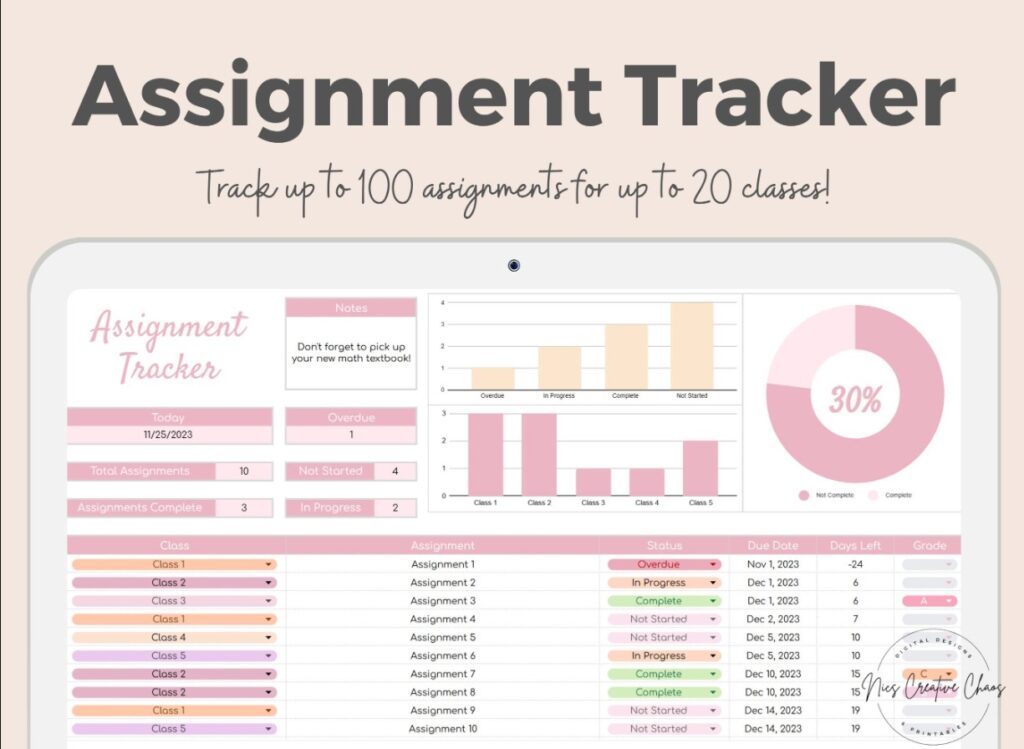
Not all assignments carry the same weight in the grade book, but many middle school students do not take the time to understand this. They spend 45 minutes carefully decorating a low-stakes creative journal entry and then rush through a research project worth 30% of their overall grade in the final 20 minutes before it is due.
Reading the class syllabus and understanding how each assignment category is weighted is an essential skill that many students are never explicitly taught. When a student knows that tests count for 40%, projects count for 30%, and daily homework counts for 15%, they can make smarter decisions about where to invest their energy.
Students who want a clear view of exactly how their individual scores combine into a final grade can benefit from using a GPA Calculator Middle School No Credits to see which assignments are dragging their average down and which areas deserve the most focused attention going forward.
Prioritizing strategically is not about cutting corners on low-stakes work. It is about recognizing where effort produces the greatest return.
6. Skipping Class or Being Chronically Late
Missing a single class in middle school can create a gap in understanding that is surprisingly difficult to fill. Teachers introduce new material almost every day. In a subject like mathematics, one absent day might mean missing the entire introduction of a new concept — and every lesson after that builds on the one that was missed.
Chronic tardiness creates a quieter but equally damaging version of the same problem. Students who arrive five or ten minutes late miss the warm-up activity, the review of the previous lesson, and the teacher’s framing of the new material. Over the course of a semester, those lost minutes add up to hours of missed instruction.
Some students genuinely believe they can catch up by borrowing a friend’s notes or reading the relevant section of the textbook. This works occasionally, but it rarely replicates the full understanding that comes from being present and engaged in real time. Attendance directly correlates with academic performance in virtually every study on middle school and high school outcomes. Showing up is foundational to everything else on this list.
7. Failing to Organize Their Materials
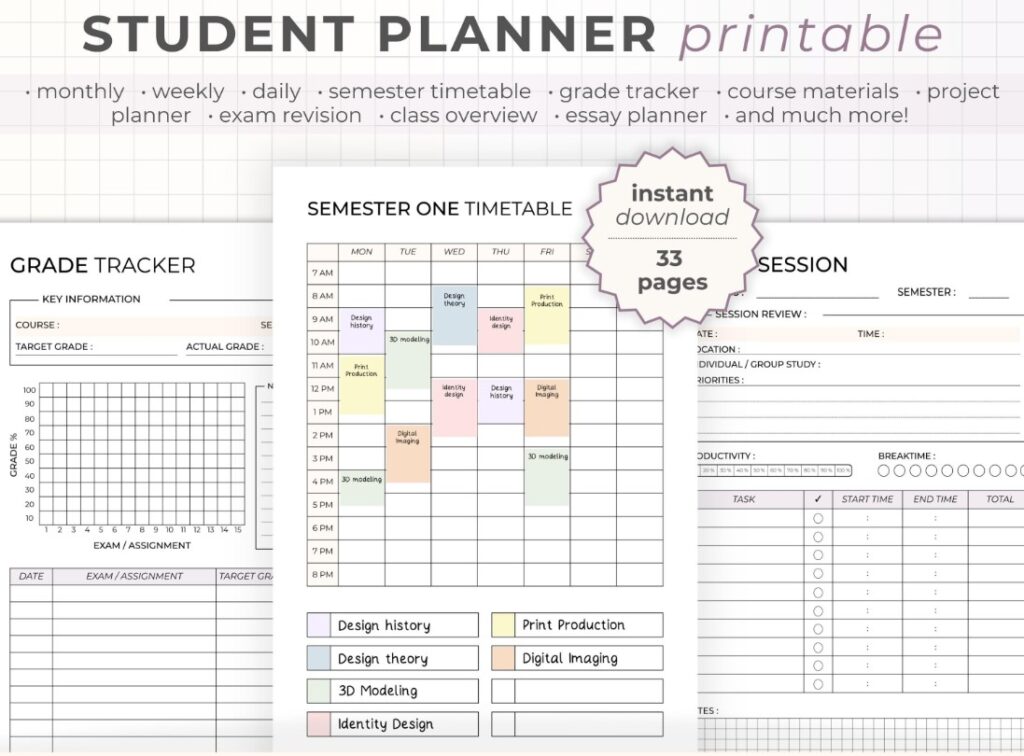
Middle school introduces a level of paper and material management that most students have never experienced before. Suddenly there are five or six subjects, each with handouts, worksheets, returned tests, study guides, and project rubrics. Students who do not develop an organizational system quickly find themselves buried in loose papers they cannot locate when they need them most.
The student who cannot find the study guide two days before the exam is at an immediate disadvantage. The student who has lost the graded rubric from the last project does not know what criteria they missed or how to score higher on the next one.
Teachers across grade levels consistently report that students with organized binders and folders perform noticeably better on assessments — not necessarily because organization makes them smarter, but because they actually have their materials available when it is time to use them.
A simple system works well: one folder per subject, papers labeled with the date, a dedicated section for returned graded work, and a weekly five-minute clean-out to remove anything that is no longer needed. That is all it takes.
8. Studying and Doing Homework in a Distracted Environment
The environment where a student does their homework has a direct impact on the quality of that work and how long it actually takes to finish. Yet most middle school students do homework with their phone sitting within reach, a video playing in the background, and notifications popping up every few minutes.
Research on multitasking has consistently demonstrated that the human brain — and especially the still-developing brain of an adolescent — does not truly multitask. What it actually does is switch rapidly and repeatedly between tasks. Every single switch costs time and mental energy. A homework session that should take 25 minutes with full focus can easily stretch to 75 minutes in a distracted environment, with lower quality output at the end of it.
Students who sit in a quiet space, place their phone in a separate room, and commit to focused work for a set period of time consistently produce better assignments and finish in less time. A simple rule like “phone goes in another room until all homework is done” sounds strict but makes a measurable difference in both grades and stress levels.
9. Not Taking Notes During Class
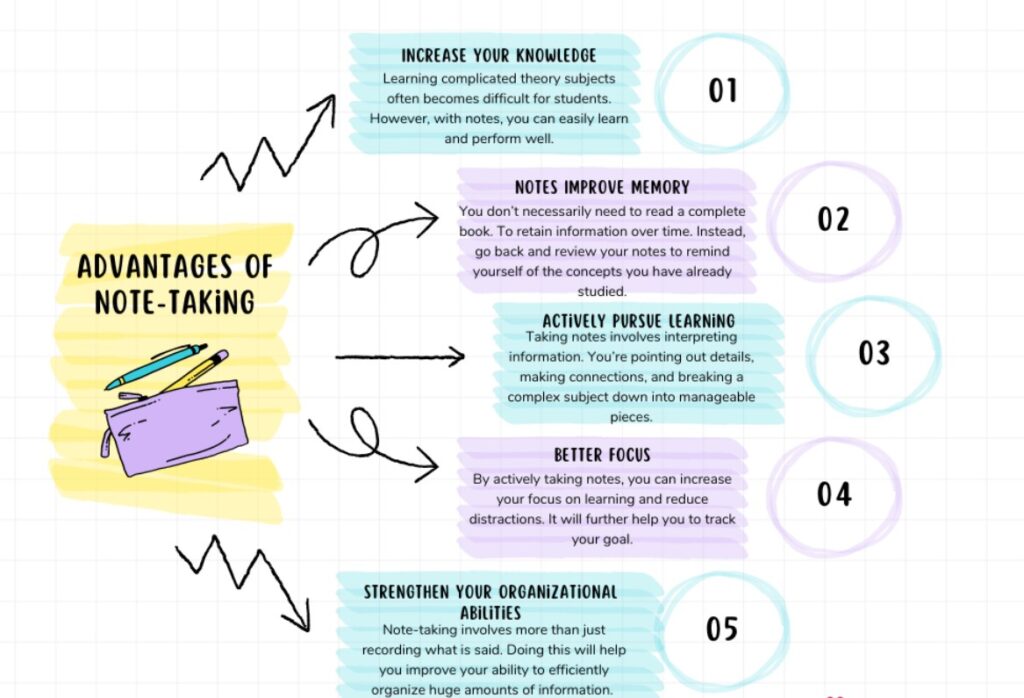
Sitting in class and listening is not the same as learning. Many middle school students believe that if they understand something while the teacher is explaining it, they will remember it well enough to perform on a test. This belief is responsible for more disappointing test grades than almost anything else.
Researchers at Princeton University and UCLA have found that students who take notes by hand during lessons show significantly stronger comprehension and retention compared to students who simply listen or even type. Handwriting notes forces the brain to process information actively — to identify what is important, summarize it in their own words, and write it down in a way that makes sense to them.
Beyond the memory benefit, notes become an irreplaceable study tool. Students who walk into a test with clear, organized, dated notes from every lesson have a powerful resource to review from. Students who have no notes are left trying to reconstruct everything from memory or rushing through a textbook re-read the night before.
Taking good notes does not require any special skill. Write the date, write the topic, and capture the key points during each lesson. That habit alone — practiced consistently — produces measurable improvements in test performance.
10. Giving Up After One Bad Grade
Of all the mistakes on this list, this one causes the most long-term damage — not just to grades, but to a student’s confidence and relationship with learning itself.
When a middle school student receives a poor grade on a test or project, a very common internal reaction is: “I’m just bad at this subject.” They decide the result reflects something permanent about their intelligence or ability and they mentally disengage. They stop putting in full effort because, in their mind, the outcome is already decided. And then, unsurprisingly, the grades continue to decline — not because they lack ability, but because they have stopped trying.
Dr. Carol Dweck, a psychologist at Stanford University, has spent decades studying this exact pattern. Her research on growth mindset demonstrates clearly that students who believe their abilities can grow through effort and practice consistently outperform students who believe their intelligence is fixed. The belief itself shapes the behavior, and the behavior shapes the outcome.
One bad grade is not a verdict. It is information. It tells a student that something did not work — the study approach, the amount of time invested, the level of understanding before walking into the test. That information is useful. It points directly toward what needs to change.
Students who respond to a poor grade by analyzing what went wrong, asking their teacher for guidance, and adjusting their approach for next time are the students who finish the year with strong academic records. The grade book is not a permanent judgment of who a student is. It is a record of how they are doing right now — and right now can always be improved.
What Parents Can Do to Help
Parents have a significant role in shaping how middle school students approach their grades — without doing the work for them. A few strategies that consistently make a real difference:
Ask about learning, not just grades. Instead of “What grade did you get?” try “What did you learn today?” or “What was the hardest part of class this week?” This shifts the focus from outcomes to process, which is where real improvement actually happens.
Create a homework environment that supports focus. A consistent, quiet workspace with the phone put away during study time removes one of the biggest barriers to quality work.
Praise effort, not just results. When a student works hard on a difficult subject, acknowledge the effort specifically — even if the grade is not perfect yet. This reinforces the behaviors that lead to long-term improvement.
Stay connected with teachers. Brief, regular communication with a student’s teachers — not to argue about grades, but to understand what skills the student is still developing — can provide early warning before a small problem becomes a serious one.
A Practical Starting Plan for Students
Real, lasting improvement does not require a dramatic overnight transformation. It requires small, consistent daily habits that compound over time. Here is a practical four-week starting plan:
Week One: Write every single assignment in a planner or notes app, every day, without exception. Build the habit before anything else.
Week Two: For any upcoming test or quiz, begin reviewing the material four days early — even for just 15 to 20 minutes per session. Notice how much more prepared it feels compared to cramming.
Week Three: After every graded assignment is returned, read every teacher comment carefully. Write down one thing to do differently on the next assignment based on that feedback.
Week Four: Reorganize the entire binder from scratch. One folder per subject. Every paper labeled with a date. A dedicated section for graded work. Spend ten minutes on Sunday each week keeping it that way.
Students who commit to these four steps consistently for a full semester have raised their grades by a full letter grade or more — not because of any magic formula, but because consistent effort in the right direction always produces results.
Summary
Middle school students often struggle with grades not because of lack of intelligence, but due to bad habits. The 10 most common mistakes are:
- Forgetting to write down assignments
- Cramming the night before tests
- Ignoring teacher feedback
- Not asking for help when confused
- Not knowing which assignments carry more weight
- Missing class or arriving late
- Being disorganized with materials
- Studying in a distracted environment
- Not taking notes in class
- Giving up after one bad grade
The good news? Every single mistake is fixable with small, consistent daily habits. Students who catch these patterns early and make simple adjustments can raise their grades by a full letter grade or more within a single semester.
Final Thoughts
Middle school grades matter — not because a single quiz in 6th grade will define a student’s future, but because the habits formed during these years are exactly the ones that carry into high school, college, and beyond. Students who learn to stay organized, ask for help, manage their time, and bounce back from setbacks are building skills that will serve them for the rest of their lives.
Every single mistake covered in this article is fixable. None of them reflect a student’s intelligence or potential. They are patterns — and every pattern can be changed the moment someone decides to change it.
The students who recognize themselves in one or more of these habits have already done the hardest part: they are paying attention. From here, improvement is simply a matter of choosing better habits, one day at a time.
Grades do not define a student. But good academic habits will absolutely shape their future — and the best time to build those habits is right now, in middle school, before the stakes get higher.
FAQs
Why do middle school students get bad grades?
Most middle school students get bad grades due to poor study habits, lack of organization, missing assignments, and not asking for help — not because of low intelligence.
How can a middle school student improve their grades fast?
Start writing down every assignment, study at least 4 days before a test, read teacher feedback carefully, and eliminate distractions during homework time.
Do middle school grades affect high school?
Yes. The habits formed in middle school directly carry into high school, where grades begin to impact college applications and future opportunities.
How many hours should a middle school student study per day?
Most educators recommend 1 to 2 hours of focused study per day, broken into short sessions of 20 to 30 minutes with small breaks in between.
What is the biggest reason middle school students fail their classes?
The biggest reason is missing or incomplete assignments. A single zero on a major assignment can significantly drag down an overall grade, making it hard to recover without extra effort.